The New Face of Europe: Six Billion Euros, One Impossible Choice
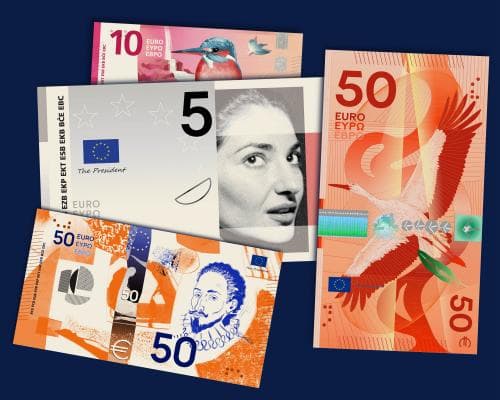
Imagine a €200 note that whispers of Beethoven’s Ninth Symphony, its ink catching the light like a piano’s lacquer. Now imagine a €5 note that carries the silhouette of a white stork, its wings outstretched over a Danube that knows no border. This is the choice before Europe, and it has ignited a passion usually reserved for auction-house showdowns or the release of a limited-edition Patek. The European Central Bank, under the impeccably poised leadership of Christine Lagarde, unveiled ten design proposals last week—the first full redesign of the euro’s paper currency since its debut in 2002. And in a move that would make any luxury maison blush, they invited the public to vote. Over six million people responded within seven days. That is more than the population of Norway, and they are all arguing about birds versus geniuses.
The stakes are higher than mere aesthetics. This is about what Europe wants to see in its pocket, in its leather wallet, in the crisp stack handed over for a bottle of Margaux in Saint-Émilion. The culture theme is a pantheon of European achievement: Maria Callas, the American-Greek soprano whose voice could shatter crystal and hearts; Ludwig van Beethoven, the German composer who turned deafness into a symphony of defiance; Marie Curie, the Polish-French scientist who twice won the Nobel Prize and died of her own brilliance; Miguel de Cervantes, the Spanish author who gave us Don Quixote, the original dreamer; Leonardo da Vinci, the Renaissance polymath who sketched helicopters and painted the Mona Lisa; and Bertha von Suttner, the Austrian pacifist who inspired Nobel’s peace prize. The reverse side of these notes would show scenes of artistic and intellectual life—a theatre, a laboratory, a library. It is a curatorial masterstroke, a walking museum of Western civilization.
The wildlife theme, by contrast, offers a quieter, more radical luxury: freedom. The wallcreeper, a bird that scales Alpine cliffs with the grace of a Balenciaga gown; the kingfisher, a jewel of iridescent blue that darts along European streams; the bee-eater, a tropical flash of yellow and green that has begun nesting in southern France; the white stork, a symbol of migration and homecoming; the avocet, a wading bird with an upturned bill that graces the salt marshes of the Camargue; and the northern gannet, a seabird that dives into the Atlantic like a pearl falling into velvet. These birds would be paired with landscapes—the Danube, the Alps, the Baltic coast—and they speak to a Europe without borders, a continent where movement is a birthright. It is an ecological, almost spiritual, vision of the Old World as a single, breathing ecosystem.
What makes this exercise so fascinating is not just the subject matter but the process. The ECB has set the denominations—€5, €10, €20, €50, €100, €200—and the colour palette, which remains in the familiar spectrum of grey, red, blue, orange, green, and yellow. The ten proposals offer different graphic interpretations, from the starkly modern to the classically ornate. The survey, which closes on 21 September, is not binding, but it is a rare moment of public consultation in the rarefied world of central banking. Lagarde, who has a penchant for silk scarves and sharp wit, has framed this as a conversation, not a decree. But the real power lies in the symbolism. A banknote is the most circulated object in a nation’s life; it is handled by the rich and the poor, the tourist and the banker. To change its face is to change the story a country tells about itself. For the euro, that story has been one of abstract bridges and generic arches—safe, neutral, and, frankly, a little dull. This redesign is a chance to inject soul into the currency that binds 340 million people.
For collectors and connoisseurs, this is a once-in-a-generation event. The first euro notes, now being phased out, have already become objects of nostalgia—and some have fetched premiums on auction sites. A new design, especially one chosen by the public, will create an immediate secondary market. Imagine a pristine €20 note with Callas’s profile, preserved in a climate-controlled sleeve, appreciating in value as the years pass. Or a €50 note with a bee-eater, its colours so vivid they seem to hum. The ECB has not announced a release date, but the process will take years—design, testing, printing, distribution. In the meantime, the debate itself is a form of luxury: the luxury of choosing what your money says about you. The birds offer a Europe that is open, wild, and unbound; the cultural figures offer a Europe of intellect, ambition, and legacy. Both are aspirational. Both are beautiful. But only one can be the face of the future.
As the survey closes and the votes are counted, one thing is certain: the winning design will be more than a banknote. It will be a mirror. For the ultra-wealthy, who think in currencies the way others think in weather, this is a reminder that money is not just a store of value—it is a statement of values. Will Europe choose the soaring stork or the brooding Beethoven? The answer will tell us more about the continent’s soul than any summit or treaty. And whether you are holding a €5 note to tip a gondolier or a €200 note to settle a private jet invoice, you will be holding a piece of that decision. That is the quiet, profound luxury of this moment: the chance to carry art, or nature, or both, in your pocket—and to know that six million voices helped put it there.