The 20.97-Second Masterpiece: Cam McEvoy’s Renaissance in the Water
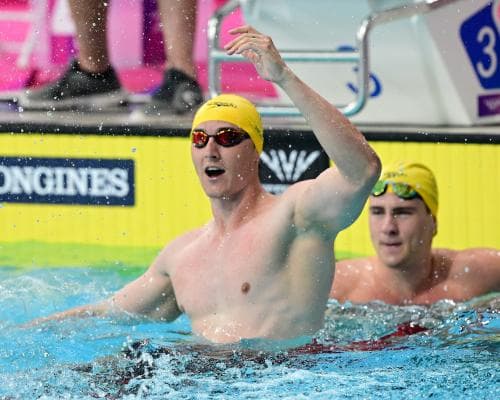
There is a particular kind of silence that falls over a pool deck when a swimmer is about to do something extraordinary. It’s not the hush of anticipation—it’s the quiet of collective disbelief, the moment before the impossible becomes the inevitable. That’s exactly what happened in Glasgow when Cam McEvoy touched the wall at 20.97 seconds in the 50m freestyle final. He didn’t just win gold; he broke the 21-second barrier for only the second time in history, and he did it with the kind of controlled fury that makes you forget he’s wearing a swim cap and not a racing livery.
McEvoy’s gold is his first individual Commonwealth title at his third Games, but the time itself is the real trophy. It follows his staggering 20.88 world record from March, a performance that felt like a message from another dimension. In a sport where hundredths of a second separate the sublime from the merely excellent, McEvoy has made a habit of living in the sublime. The 50m freestyle is the sprinter’s event—a one-lap dash that demands explosive power, flawless technique, and a mind that can compress years of training into a single, breathless 21-second burst. McEvoy has mastered that compression. His victory in Glasgow wasn’t just a win; it was a statement of intent for the 2028 Los Angeles Olympics, where he’ll defend his Paris gold.
What makes McEvoy’s story so compelling isn’t just the numbers—it’s the craftsmanship behind them. After a disappointing Tokyo Olympics, he nearly walked away from the sport entirely. He took a sabbatical, stepped back from the relentless grind of elite swimming, and then returned with a completely overhauled training regimen. He calls it “open-sourcing” his approach—sharing his methods with the world, challenging the secrecy that often surrounds elite athletic preparation. It’s a philosophy that feels more like a Swiss watchmaker publishing his blueprints than a swimmer hoarding secrets. The result is a body that moves through water with a kind of hydraulic precision, each stroke a calculated reduction of drag. His Glasgow swim was a masterclass in efficiency: a start that exploded off the blocks, a turn that was almost too fast to follow, and a finish that left his competitors gasping for air.
The rarity of sub-21-second swims cannot be overstated. Before McEvoy, only a handful of humans had ever done it. To do it twice in a single year—and to lead an Australian medal sweep in the event, with Flynn Southam and Jamie Jack taking silver and bronze—places him in a category that feels almost mythological. It’s the kind of performance that collectors of rare experiences would pay any price to witness. And yet, McEvoy remains remarkably grounded. “I really wanted to prove to myself that I can consistently get under that,” he said after the race. “It brings me a lot of confidence for the world championships next year, LA, moving forward.” There is no arrogance here, only the quiet satisfaction of a man who has rebuilt himself from the ground up.
For the ultra-wealthy who follow sport, McEvoy’s trajectory is a lesson in the value of reinvention. He represents a kind of luxury that can’t be bought—only earned through discipline, failure, and the willingness to start over. In a world of instant gratification, his story is a reminder that the most exquisite things take time, patience, and a willingness to dismantle what you thought worked. His training methods, now open-source, have become a kind of intellectual property that money can’t replicate. You can’t buy the muscle memory of a man who has swum thousands of laps in pursuit of a single second.
Looking ahead, McEvoy’s eyes are fixed on Los Angeles 2028. He knows the world is getting faster. “I can’t just cruise into it,” he says. That awareness—that edge of paranoia mixed with confidence—is what separates the good from the great. For the rest of us, watching from the shore, his swims are a rare glimpse into what happens when human potential meets relentless refinement. It’s not just a race; it’s a performance piece, a living sculpture of speed. And in Glasgow, he added another masterpiece to his collection.