The New Pilgrimage: Why the Ultra-Wealthy Are Walking to Canterbury
The choristers’ voices rose through the honeyed stone of Canterbury Cathedral, and for a moment, the heat outside ceased to exist. I had arrived in the city just an hour earlier, wilting under a midsummer sun that made Chaucer’s bronze statue on High Street hot to the touch. But inside the quire, with the white-and-purple robes of the choir and the ancient syllables of Evensong—æfensang, the Old English word that replaced “vespers”—everything slowed. This was not a tourist trap. This was an overture. And it signaled something the luxury world has been slow to notice: the revival of pilgrimage as the ultimate status journey.
Here is the surprising number: 3.7 million British adults have already made a pilgrimage, and nearly one in five are considering one, according to a 2025 YouGov study for the British Pilgrimage Trust. That is not a niche of backpackers. That is a movement. Torin Brown, the pilgrim officer at Canterbury Cathedral, told me the resurgence has accelerated since Covid. “People are looking back to the old ways in their search for meaning,” he said. Even atheists, he noted, are walking to sacred spaces. The murder of Archbishop Thomas Becket in 1170 made Canterbury one of Europe’s most popular pilgrimage destinations, and today, the routes are buzzing again: the Pilgrims’ Way from Winchester, the Old Way from Southampton, the Augustine Camino from Rochester. The new archbishop, Sarah Mullally, walked from St Paul’s Cathedral for six days before her installation in March. My own plan was the English leg of the Via Francigena—the ancient road that links Canterbury to Rome. Twenty miles to Dover. An OS map, a pilgrim passport, and a single day on foot.
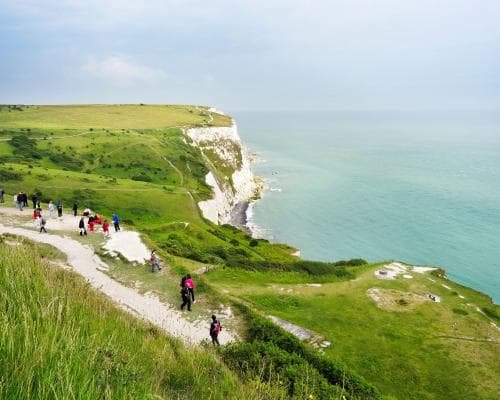
Now, let’s talk about what this means for the connoisseur of rare experiences. You have chartered superyachts in the Maldives. You have skied private heli runs in Hokkaido. But have you walked a medieval pilgrimage route without a single piece of branded luggage? The beauty here is the absence of luxury as you know it. There are no five-star hotels on the Via Francigena—only modest inns, ancient pubs, and the occasional farmhouse. The real rarity is time. Uninterrupted, slow, deliberate time. The kind of time that cannot be bought at a concierge desk. The walk from Canterbury to Dover follows chalk downs and cliff edges, past the same fields that Chaucer’s pilgrims would have seen. The white cliffs themselves appear as a shock of brilliance at the end of a long, sweaty day. That view is the ultimate reward, and it costs nothing but effort. That is precisely why it is priceless.
What does this signal about wealth and taste? The ultra-wealthy are increasingly hungry for what cannot be commodified. A Hermès Birkin is beautiful, but a pilgrim passport stamped at a cathedral is a story. The new status symbol is not a watch—it is a callus on the heel. It is the ability to say, “I walked from Canterbury to Rome,” and mean it. The market for transformative travel is exploding, and pilgrimage sits at its apex. It is not a vacation. It is a voluntary hardship that yields clarity. The same people who once collected wine cellars are now collecting walking routes. They want provenance in their experiences, not just their assets. The British Pilgrimage Trust reports that almost one in five adults are considering a pilgrimage. That is a demographic shift that the luxury sector ignores at its peril.
So where does this go? The future of elite travel is not faster—it is slower. It is not more exclusive in the sense of velvet ropes; it is more exclusive in the sense of willingness to suffer beautifully. I suspect we will see private pilgrimages curated by historians, with support vans carrying Champagne and orthopedic insoles. But the core will remain unchanged: a walk, a destination, a transformation. The Via Francigena is already seeing a rise in bespoke guided journeys. The smart money is betting on the ancient path. After all, as HV Morton noted in 1939, Canterbury was noisy then, too. But the pilgrimage endures. And now, it is the quietest luxury of all.
The Experience
To walk the Via Francigena from Canterbury to Dover with a private historian guide and support vehicle, contact our travel desk for a bespoke itinerary that includes pilgrim passport, OS maps, and a post-walk dinner at a Michelin-starred Kent estate.