Britain's Jurassic Gold Rush: The Fossil Hunters Cashing In on a 190-Million-Year-Old Boom
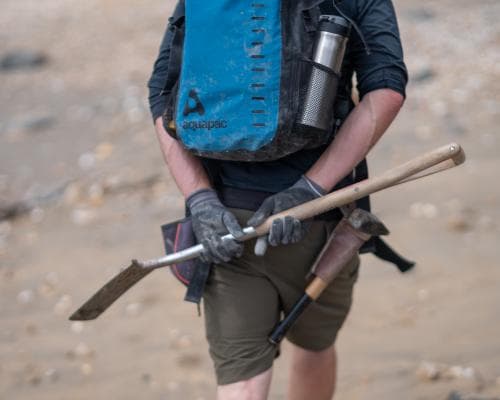
On a grey Tuesday morning, Martin Curtis is bent double over a stretch of Charmouth beach, his eyes tracing the shingle with the intensity of a man reading a stock ticker. He's not looking for loose change or a lost ring. He's hunting for the spiral of an ammonite, the star-shaped stem of a crinoid, or a rock whose odd colour and texture might just hide a creature that died 190 million years ago. It looks like a hobby. It's increasingly a business.
Fossil hunting along the Jurassic Coast has always drawn families and curious amateurs. But the past decade has turned it into something else: a genuine gold rush, where the right find can fetch five figures, and a well-curated collection can command eight. The Guardian's investigation this week revealed that one of Britain's most significant private collections — 318 specimens amassed by Chris Moore, a lifelong collector from the Isle of Wight — was quietly sold to a museum in Abu Dhabi for what industry insiders believe to be an eight-figure sum. Some of those specimens may represent species unknown to science. And British museums, despite their expertise and desire, simply didn't have the money to compete.
That's the uncomfortable arithmetic at the heart of this story. The UK's great natural history institutions operate on budgets that look like pocket change next to the sovereign wealth of the Gulf. A museum in Abu Dhabi can write a cheque for a collection that the Natural History Museum or the Dorset County Museum would struggle to match, even with lottery funding and corporate sponsorship. The result is a transfer of Britain's deep-time heritage to a region that is aggressively building cultural credibility through acquisition. It's the same playbook we've seen in art, luxury real estate, and now — literally — in rocks.
For the fossil hunters on Charmouth beach, the Abu Dhabi sale is not a distant headline. It's a signal. It tells them that the market for Jurassic fossils is not just alive, but accelerating. The trade in ammonites, ichthyosaur skeletons, and marine reptiles has been quietly professionalised over the past two decades. Online auction platforms, Instagram dealers, and a new generation of collectors with disposable income have created a liquid market where a well-prepared specimen can sell for tens of thousands of pounds. The most spectacular finds — like the 2017 sale of a 180-million-year-old ichthyosaur for over £100,000 — make headlines, but the real money is in the steady, unglamorous trade of quality specimens.
What's driving this? Three forces. First, scarcity: the Jurassic Coast is a finite resource, and as more collectors comb the beaches, the odds of finding a major specimen shrink. Second, cultural demand: wealthy buyers in Asia and the Gulf are treating fossils as status objects, alongside contemporary art and vintage cars. Third, the democratisation of knowledge: online forums and identification apps have turned amateur hunters into informed prospectors, and the barriers to entry are lower than ever. A family with a hammer and a chisel can, in theory, stumble on a life-changing find — and that lottery-ticket hope is part of the appeal.
But there's a darker side. The commercialisation of fossil hunting has raised questions about scientific access. When a unique specimen disappears into a private collection in Abu Dhabi, researchers lose the chance to study it. The Museum of Jurassic Marine Life in Kimmeridge, where Moore's collection was once housed, has closed its doors — a casualty of the sale. British palaeontologists are watching their field's most important artefacts migrate to countries with deeper pockets. It's a story we've seen in antiquities, in manuscripts, and now in natural history. The wealthy don't just buy what's on the market; they define what the market is.
For the individual hunter, the calculus is simple: every stone is a potential call option on a 190-million-year-old payout. And as long as Gulf museums and private collectors are willing to pay eight figures for a single collection, the incentive to keep looking will only grow. The Jurassic Coast may be a UNESCO World Heritage Site, but it's also a speculative frontier. For the wealthy, it's an asset class that can't be printed, can't be diluted, and — unlike a stock or a bond — carries the romance of deep time. That's a combination the world's richest are finding increasingly hard to resist.
The next time you see a family bent over the shingle at Charmouth, don't mistake them for tourists. They're prospectors, chasing a fortune that's been buried for 190 million years. And the only thing growing faster than the value of their finds is the gap between who can afford to keep them and who can't.
More in MONEY