The Open 2026: Royal Birkdale's Rich Get Richer — And the Smart Money Follows
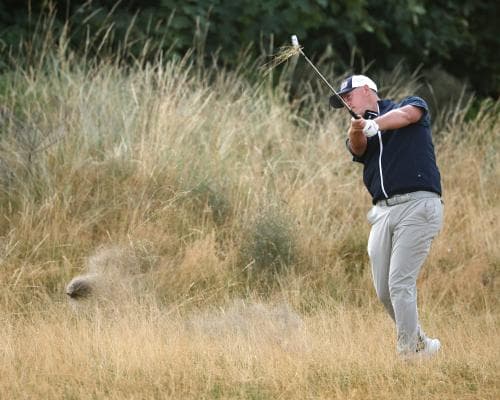
Padraig Harrington calls the 514-yard par-four 6th at Royal Birkdale 'probably the toughest hole on the front nine.' Thomas Detry just learned that lesson the hard way — zig-zagging from thick rough to deeper rough, then into a native area, before wedging out to 15 feet and saving bogey. It’s the kind of gritty, high-stakes scramble that separates contenders from pretenders. And it’s exactly why the smartest capital in the world pays close attention to this tournament.
This is not a golf update. This is a masterclass in how elite performers manage risk, allocate resources, and protect their positions under extreme pressure. Bob MacIntyre — last year’s US Open runner-up — opened with a 45-foot birdie putt from the front edge of the first green, then stuck his second shot at the 2nd to a foot and a half. He’s at -2 through two holes. Matthew Southgate, who finished sixth here in 2017 after a spectacular 67-65 weekend, drained a putt on 1 from what the announcers call 'Bob MacIntyre Country.' The local lad Matthew Baldwin is -1 through five. The field is deep, the conditions are brutal, and the margins are razor-thin.
Let’s talk about the mechanics of this wealth event. Royal Birkdale is a classic links course — wind, undulating fairways, firm greens, and penalties for every misstep. The 6th hole alone is a 514-yard left-to-right par-four that demands a precise tee shot, a long iron into a green guarded by bunkers, and a short game that can save par from anywhere. The numbers tell the story: Detry’s bogey came after three separate recovery shots. MacIntyre’s birdie came from 45 feet. The difference between a 68 and a 78 is often just a few inches of luck — or a few decades of discipline.
The rarity and heritage here are enormous. The Open is the oldest major championship in golf, dating back to 1860. Royal Birkdale has hosted it ten times, producing champions like Arnold Palmer, Lee Trevino, Tom Watson, and Padraig Harrington. The trophy is the Claret Jug. The prize money this year is $16.5 million, with $3 million to the winner. But for the ultra-wealthy — the billionaires, the family offices, the hedge fund partners who fly in by private jet — this week is not about the purse. It’s about the signal. Who handles the pressure? Who folds? Who makes the putt when it matters? That’s the same calculus they use when allocating capital to a new fund or a distressed asset.
What does this signal for markets and the wealthy? First, that the appetite for live, high-stakes experiences is stronger than ever. The Open generates over $200 million in economic impact for the host region, and hospitality packages for the super-rich sell out months in advance. Second, that the skills required to win here — patience, risk management, and the ability to recover from setbacks — are exactly the skills that compound wealth over decades. Bob MacIntyre, at 28, is already showing that he can handle the big stage. Matthew Southgate, at 37, is proving that experience and local knowledge matter. The market is paying attention.
Looking ahead, the leaderboard after day one is just the first chapter. The wind is forecast to pick up. The rough will get thicker. The pressure will mount. For the money crowd watching from the clubhouse, the real action is in watching who adapts — and who breaks. In golf, as in markets, the winners are the ones who stay disciplined when everyone else is zig-zagging. The smart money is already placing its bets.