The New Couture: Pierpaolo Piccioli’s Balenciaga Reimagines the Architecture of Air
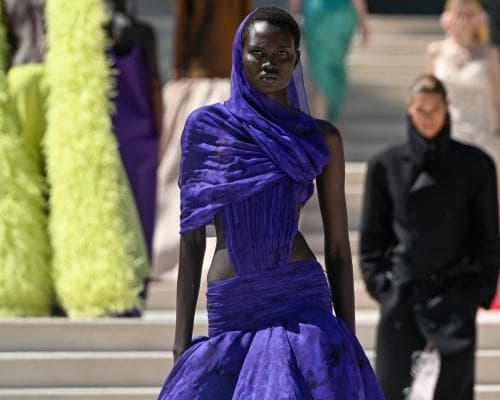
The house of Balenciaga takes haute couture very seriously indeed. Cristóbal Balenciaga was so horrified by the rise of mass-produced clothes that in 1968 he abruptly shuttered his brand and retired to his native Spain, announcing that “high fashion is mortally wounded.” So Pierpaolo Piccioli, who now helms the house, approached the brief of his first Balenciaga couture collection conscientiously, despite having 25 years of experience at Valentino. At a preview, the haute couture war room where he worked on the show for nine months was plastered with images that ranged from a 1961 Balenciaga dress to Spanish golden age art – Zurbarán’s chic saints, Velázquez’s doll-like infantas – and a monumental Hepworth pierced megalith.
Balenciaga’s house style is clothing that stands proud of the body. The organic cocoon curves and bell shapes, with room beneath for air to move around the body, arguably share more DNA with a Hepworth sculpture than with leggings and a tank top. There is a distinctly Zurbarán-adjacent air of mystery and wonder in how the fabric is made, through cut alone, to hover in space rather than cling. To Piccioli, Balenciaga was “a philosopher for the way you feel in a dress.” As luck would have it, a show nine months in the planning was staged under a blistering Paris sun during a heatwave which has made airy clothes that don’t touch the body look extremely appealing. The embroidered silk gazar of a bustier dress cantilevered out from the body, the fabric bouncing around the model as she walked. (A dense motorcycle helmet-shaped headpiece of ostrich feathers perhaps looked less tempting.)
Piccioli took on Balenciaga’s couture heritage with respect but on his own terms. He is a thoroughly modern designer, jeans and sunglasses to Cristóbal’s double-breasted tailoring. Yet his collection was a rigorous study in the founder’s obsession with volume and negative space. Each piece was a lesson in engineering: a cape that seemed to levitate, a gown that was more air than cloth. The materials were the finest silk gazar and organza, sourced from the same ateliers that served the original house. The embroidery alone took hundreds of hours, with floral motifs that referenced both Spanish still lifes and contemporary botanical photography. This is not fashion for the impatient; it is for those who understand that true luxury is time made visible.
The market for such pieces is, of course, rarefied. Couture clients are a tiny, global tribe of collectors who commission one-of-a-kind garments for events that may never happen again. Prices for a Balenciaga couture piece start in the tens of thousands and can climb well into six figures. Yet the value is not merely in the materials or the name; it is in the story. A Piccioli Balenciaga dress is a conversation between two eras, a dialogue between a Spanish master and an Italian romantic. For the ultra-wealthy, owning such a piece is akin to commissioning a portrait from a living artist—it is a marker of cultural fluency, not just financial means.
What this collection signals about luxury taste today is a shift from logo-driven status to intellectual sophistication. The quiet confidence of a garment that does not shout but rather hovers, that invites the eye to explore its construction, is the new currency among those who have already acquired everything. Piccioli’s Balenciaga is for the collector who values the hand of the artisan over the flash of the brand. It is a reminder that in an age of fast everything, the slow, deliberate creation of beauty remains the ultimate statement.
Looking forward, Piccioli’s debut suggests a future where heritage houses are not museums but living laboratories. Balenciaga, once mortally wounded by mass production, is reborn as a beacon of what fashion can be when it respects its past while daring to breathe new air. For those who can afford it, this collection is not just clothing; it is an investment in the art of possibility.