The Beaver’s Return: Why the Ultra-Rich Are Hiking France’s Most Exclusive New Trail
We were sipping chestnut kir on a terrace above the Tarn River when the table next to us erupted in hushed French. “Regardez! C’est un castor!”
Below us, a beaver the length of my leg swam upstream with lazy confidence. No binoculars needed. The water was so clear we could count every pebble, every ribbon of weed, every trout sliding through the jade-green current. Above, vultures cruised the thermals in groups of nine or ten. On the bank, orchids bloomed in profusion: monkey, bee, military, butterfly, pyramidal, fragrant. Later we learned that thirty varieties have been recorded here.
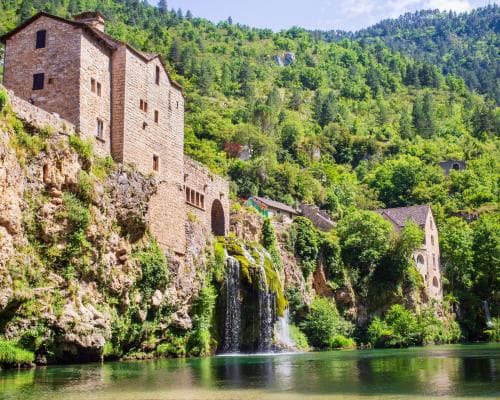
This is the Gorges du Tarn — Europe’s longest and most dramatic canyon, a 33-mile limestone gully where cliffs rise 500 metres above the river. And since 2023, a new 300-kilometre hiking route called the GR736 has opened the entire length of this wilderness to those who know how to walk with style.
The route runs from the Tarn’s source on the heathery uplands of Mont Lozère all the way to the city of Albi. Three of its five days cut directly through the gorge itself. You walk ten to fifteen miles a day, unimpeded by backpacks. Your luggage travels in a minivan that arrives promptly at 9am each morning. This is not roughing it. This is disciplined discovery.
The gorge is home to more than 3,000 vultures, plus cuckoos, nightingales, red-billed choughs, owls, otters, kingfishers, herons, and now — beavers. The microclimate here is cooler, greener, more alive than the surrounding plateaus. It feels like a secret garden that only reveals itself to those willing to move at three miles an hour.
Along the way, you encounter a succession of medieval towns, abandoned hamlets, deserted churches, ruined castles, and crumbling terraces. Most can only be reached on foot, via “balcon” paths that are dizzyingly — albeit safely — carved into the gorge walls. The first of these is Castelbouc, a semi-troglodytic hamlet of narrow cobbled streets watched over by the remnants of a castle balanced on a vertiginous spur. Then Sainte-Enimie, one of France’s celebrated “plus beaux villages,” where honey-coloured houses are hung with pink roses and the steep streets lead to a thriving local life that feels untouched by the century.
For the ultra-wealthy, this is not a vacation. It is a recalibration. The GR736 offers something that no five-star hotel can: total seclusion in a landscape that demands nothing from you except your presence. There are no helicopters, no private chefs, no infinity pools. There is only the rhythm of your own footsteps, the smell of wild thyme crushed underfoot, and the occasional sight of a beaver swimming home.
This is luxury as subtraction. The removal of everything unnecessary. The signal it sends is not about what you can afford, but about what you understand. You understand that the rarest commodity in the modern world is not a Birkin bag or a limited-edition Patek Philippe. It is silence. It is a view that has not changed in a thousand years. It is the knowledge that you are walking the same path that pilgrims, shepherds, and hermits walked before you.
The best times to go are April, May, early June, and late September. The crowds are thin. The light is golden. The orchids are in bloom. And the beaver is waiting.
This is what wealth looks like when it has nothing to prove.
The Experience
Book a private guided walking itinerary along the GR736 through a bespoke travel curator like Black Tomato or Remote Lands, who can arrange luggage transfers, private guides, and stays in restored medieval auberges along the route.