The Art of Agelessness: How Messi, Ronaldo, and Football’s Elite Are Redefining Longevity
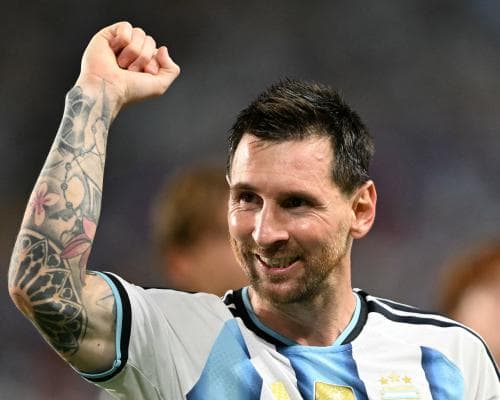
There is a photograph that stops you cold. Lionel Messi, 39, drifting through a crowded penalty area in Argentina’s sky-blue stripes, his body a whisper of motion while defenders around him seem to move through honey. The ball arrives at his left foot, and in that fraction of a second, the chaos of the game becomes a still life of intention. He scores. Again. This is not a nostalgic flashback. It is a Tuesday in 2026.
We have grown accustomed to treating elite athletes as perishable goods—fine wines with a short drinking window. But something has shifted in the ecosystem of top-tier football. As Emma Hayes recently observed, the record for most goals in a single World Cup (Just Fontaine’s 13 in 1958) may fall this summer, not because players are faster or stronger, but because they are smarter. The modern finisher operates from the neck up as much as from the hips down. Positioning, instinct, timing—these are the currencies of longevity. And the men and women who possess them are refusing to retire.
Consider the discipline required. Messi, now 39, and Cristiano Ronaldo, 41, are not anomalies; they are the vanguard of a new paradigm. They live and breathe the lifestyle of a professional athlete with a rigor that would make a Swiss watchmaker blush. Their diets are calibrated to the micronutrient. Their recovery methods—cryotherapy, compression, sleep tracking, hyperbaric chambers—would have seemed like science fiction a generation ago. They do not drink. They do not burn the candle at both ends. They have turned their bodies into temples, and the result is that the decline curve that once flattened careers at 33 now bends gracefully into the forties.
Robert Lewandowski, thriving at 37, is a case study in biomechanical refinement. He has learned to master crowded penalty areas not by outrunning defenders but by outthinking them. His movement is a choreography of decoys and micro-adjustments. Harry Kane, 32, is another devotee of the new longevity gospel—a total professional whose physical preparation is as meticulous as his finishing. And then there is Marta, the Brazilian legend, still scoring sublime goals at 40, proving that the template is not limited to men. The next generation—Erling Haaland, with his sculpted physique and obsessive recovery—is already following the blueprint.
For collectors and connoisseurs of excellence, this shift carries profound implications. The ultra-wealthy have long understood that rarity appreciates with time. A first-edition Patek Philippe, a 1962 Ferrari 250 GTO, a case of Romanée-Conti—these are assets that become more valuable as the years pass. Now, the same logic applies to athletic performance. Watching Messi at 39 is not a farewell tour; it is a masterclass in sustained peak performance. The market for such moments—tickets, hospitality, memorabilia—is booming. A match-worn shirt from a 40-year-old Messi might one day eclipse the value of his younger self’s kit, because it represents something rarer: the defiance of entropy.
What this signals about luxury taste is subtle but unmistakable. The new status symbol is not a faster car or a bigger yacht. It is the ability to remain relevant, vital, and excellent long after others have faded. It is the discipline to say no to excess, the investment in recovery, the quiet intelligence of positioning over brute force. The ultra-wealthy are increasingly drawn to this ethos—curating their own lives with the same precision that these athletes apply to their bodies. A private chef, a dedicated sleep coach, a hyperbaric chamber in the basement of a Bel Air mansion: these are the new signifiers of a life well curated.
Looking forward, the question is not whether Messi and Ronaldo can play into their 40s—they already have. The question is how far the boundary can be pushed. If the brain is the true engine, and the body is merely the chassis, then 42, 43, even 45 may become plausible for the most disciplined. Imagine a World Cup in 2030 with a 43-year-old Messi gliding through the final third. It sounds like fantasy. But so did a 39-year-old scoring in a World Cup knockout match a decade ago. The future belongs to those who curate their own time. These athletes are showing us how.