A Final Curtain: Cristiano Ronaldo’s Last World Cup, and the Quiet Dignity of an Unfinished Legend
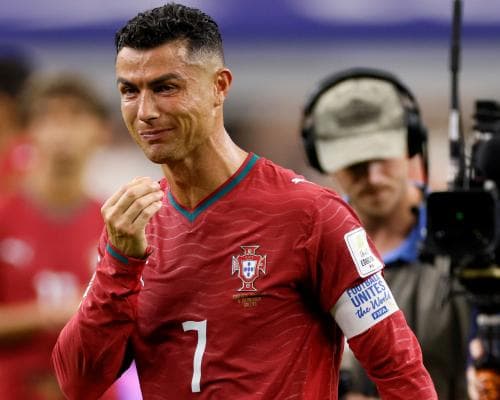
The moment came without fanfare. A late Spanish goal in Dallas, a 1-0 defeat, and suddenly the most decorated career in international football had reached its final World Cup chapter. Cristiano Ronaldo, 41, stood on the pitch in the sweltering Texas evening, his 233rd cap for Portugal behind him. He is the only man to have scored at six World Cups, and he departs with something rarer than a trophy: a clear conscience.
“I am sad to leave like this,” he said afterward, his voice measured, unhurried. “But I have given everything, always given my best. I go with a clear conscience. This is football, it is the life of a footballer. Sometimes you win, sometimes you lose.” There was no dramatic farewell, no tears. Just a man who knows exactly what he has built. For the ultra-wealthy collector — of watches, of cars, of moments — this is the kind of exit that commands respect. Not a crash, but a deliberate, graceful deceleration.
Ronaldo’s career has always been about precision and rarity. Think of a bespoke Tourbillon movement, hand-finished and assembled over months. His 900-plus career goals are the mechanical components; his six World Cup appearances are the jewels. But what sets him apart in the pantheon of sporting luxury is his refusal to inflate his own mythology. When asked about Portugal’s 2016 European Championship win, he said simply: “For me, it has the same dimension as the World Cup. Before Cristiano, Portugal had never won a big trophy.” He does not need to compare. He knows the value of what he holds.
The match itself was unremarkable — an unimpressive display from Portugal, a late Spanish dagger. Manager Roberto Martínez offered only praise. “He has been an exemplary captain,” Martínez said. “I arrived when there was a lot of confusion and questions in terms of his position in the team. But he has been an example not only in the number of goals he has scored, but in how he handled it all.” That handling — the quiet dignity of a man who has been the center of the universe for two decades, now stepping aside without drama — is the kind of behavior that defines the truly tasteful. In a world of flashy exits and manufactured narratives, Ronaldo chose authenticity.
For the collector, there is a lesson here. The most valuable pieces are not always the loudest. A 1963 Ferrari 250 GT Lusso is quieter than a LaFerrari, yet it commands comparable reverence. A Patek Philippe Calatrava whispers where a Nautilus shouts. Ronaldo’s legacy is like that: built on substance, not hype. He leaves the World Cup stage having scored in 2002, 2006, 2010, 2014, 2018, and 2022 — a record that will likely never be matched. But he leaves also with the knowledge that he defined an era. “I won three titles with Portugal,” he said. “The best trophy I won with the national team was 2016.” That is not modesty. That is the confidence of someone who knows his own catalog.
What comes next remains unwritten. “There will be time to think, to be with my family,” he said. “I will not make decisions in the heat of the moment.” For a man who has spent 23 years at the apex of global sport, the quiet after the final whistle is perhaps the most luxurious thing of all. The private jet, the superyacht, the hypercar collection — those are the trappings. The true luxury is the space to decide, on one’s own terms, what the next chapter holds.
Ronaldo’s last World Cup was not a coronation. It was a quiet, dignified closing of a door. And in that, it was perfect. Because the best exits are not the ones that make headlines — they are the ones that leave you wanting to know what happens next. The story is not over. It is simply, elegantly, moving to its next gear.