The Eternal Comeback: Messi’s Tears of Joy and the Art of Never Yielding
The image is almost too perfect for a magazine spread: Lionel Messi, the man who has spent two decades wearing cool detachment like a bespoke suit, weeping with joy. His face is wet, his eyes are red, and he is surrounded by a tangle of blue-and-white shirts that move like a single, ecstatic organism. This is not a painting. This is the 2026 World Cup last-16, and Argentina have just pulled off one of the great comebacks in the tournament’s history. Forget the missed penalty that could have been a death sentence. Forget the two-goal deficit that felt like a trapdoor opening under the champions. In four minutes and eighteen seconds, Messi did what he has always done: he bent reality to his will.
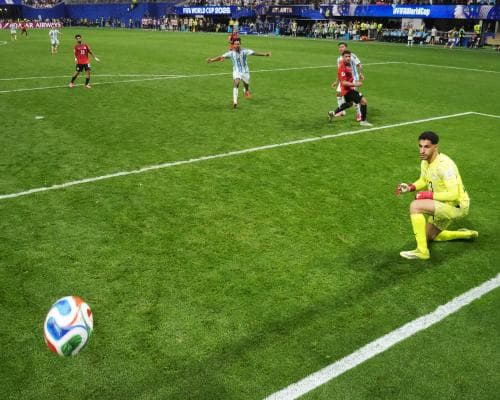
Let’s set the scene. Egypt, disciplined and dangerous, had built a richly deserved 2-0 lead. Mo Salah was playing with the kind of quiet fury that makes defenders sleep badly. The upset of the tournament was materializing in real time. Then came the penalty miss—a rare, jarring crack in the armor. For most players, that moment would be a ghost that haunts the rest of the match. For Messi, it was a prelude. He did not sulk. He did not hide. He simply recalibrated. His assist and goal, delivered in that frantic four-minute window, were not just technical brilliance; they were a lesson in emotional architecture. He pulled his team level as if he were pulling a thread from a tapestry, and then Enzo Fernandez, in added time, finished the weave. Egypt stared into the distance, their dream dissolving. Salah, bereft. But here’s the truth that will matter later: Egypt didn’t throw anything away. They simply came up against a force of nature with genius in his boots.
What makes this moment so intoxicating for the collector of rare experiences is the rawness of it. In a world where luxury often polishes every edge until it gleams, Messi’s tears are a reminder that the most valuable things are unvarnished. This is not a victory lap; it is a resurrection. The missed penalty, the two-goal deficit, the 11 minutes of added time—these are the imperfections that make the final result a masterpiece. For the ultra-wealthy who spend millions on a vintage Ferrari that has a dent in the door because it tells a story, or on a first-edition book with a coffee stain from the author’s own hand, this match is the same kind of acquisition. It is a moment of supreme vulnerability that ends in triumph. Argentina had never come back from two goals down to win a World Cup match. Now they have. That statistical rarity is the kind of footnote that turns a game into a legend.
From a market perspective, this is the kind of narrative that drives value in intangibles. Think of it as the emotional equivalent of a Patek Philippe that was worn by a polar explorer—its worth is not in the gold or the movement, but in the story of survival. Collectors of moments, whether they buy tickets to finals or commission portraits of their heroes, will pay a premium for this kind of drama. The missed penalty becomes a signature, like a flaw in a diamond that makes it one-of-a-kind. And for Argentina, the path forward is now lined with the knowledge that they have already faced the abyss and refused to fall. That psychological armor is priceless. Egypt, meanwhile, will be consoled by the fact that they did not lose; they were simply out-gunned by a man who refuses to let the story end on anyone else’s terms.
What this signals about luxury taste is a shift away from the pristine and toward the authentic. The ultra-wealthy are increasingly drawn to experiences that have texture—that carry the grit of real struggle. A perfect, sterile victory is forgettable. A comeback that requires tears, a missed penalty, and a four-minute burst of genius is the sort of thing you tell your grandchildren about. Messi’s tears are not a sign of weakness; they are the ultimate luxury: proof that he cares so deeply that his body cannot contain it. In a world of curated perfection, that is the rarest commodity of all.
Looking forward, this match will be remembered as the moment Argentina proved they have the spine to win ugly, to win through chaos. For the rest of the tournament, every opponent will know that even a two-goal lead is not safe. Messi, now 39, is playing on borrowed time, but time bends to his will. If this is the beginning of the end of his World Cup journey, it is a glorious, messy, exquisite chapter. For those of us who collect stories, this one is already framed and hung on the wall.