The Last Red Sails: Chartering a 19th-Century Thames Barge Is the Ultimate Escape
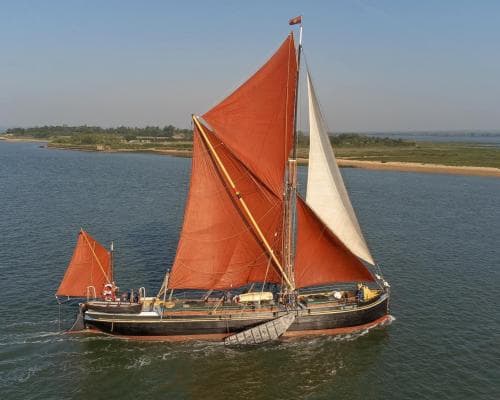
There is a moment, somewhere between the third Pimm's and the first plunge off Shingle Point, when the phone becomes a paperweight and the mind finally stops its relentless scroll. That moment is not found in a five-star spa or a private island. It is found on the deck of a 127-year-old wooden barge, drifting up the Blackwater estuary with nothing but the creak of rigging and the slap of tide against oak. I hadn't felt this present in months. Neither, apparently, had anyone else aboard.
This is the world of the Thames sailing barge—a flat-bottomed, red-sailed workhorse that once ruled the river's estuary, carrying grain, cement, and coal from the North Sea into the heart of London. In the 19th century, thousands of these ochre-sailed vessels pierced the skyline, their shallow drafts letting them glide upriver in as little as a metre of water. Bargemen would boast they could sail anywhere there had been a heavy dew. Their genius was efficiency: a rig of winch-set sails meant a crew of just two—skipper and mate, plus a guard dog—could shift 150 tonnes of cargo. That economy kept them alive long after other commercial sail had vanished, right up to the 1960s, when men like 86-year-old Barry Pearce took the helm.
Pearce is one of the last living skippers who worked these barges for a living. He still recites the names of every vessel he commanded—Remercie, Edith May, Colonia—from a terrace house in Maldon that feels more like a ship's cabin, with laundry strung on ropes beneath a lantern and a mongrel named Winkle at his feet. Today, only about 30 Thames barges remain afloat, and just a handful are in sailing condition. Two of them, Pudge and Centaur, lie like beached krakens on the mudflats of Maldon's Hythe Quay, restored and run by the all-volunteer Thames Sailing Barge Trust. Centaur, built in 1895, is the one I boarded on a scorching evening, ready for a weekend that promised nothing more than tide, wind, and the Essex coast.
What unfolds is not a luxury cruise in any conventional sense. Cabins are basic—a washbasin, a bunk, a porthole—but the real opulence is the experience. The itinerary is fluid, shaped by passengers' whims: a sail up the Blackwater, a Pimm's at Tollesbury Marina, a swim off Shingle Point, a wander around Mersea Island. The crew is a motley trio of trainees overseen by skipper Chris Martin, a boatbuilding teacher who makes it clear that handling the barge is optional. I am the only non-sailor among six passengers, yet within hours I am hauling a rope, feeling the grain of the wood, understanding why bargemen called their craft 'the perfect machine.'
This is wealth redefined. Not the wealth of a private yacht with a helicopter pad, but the wealth of time, of heritage, of being present in a place that has not changed in over a century. For the ultra-wealthy, who can buy anything, the rarest commodity is a moment that cannot be replicated. A Thames barge charter offers exactly that: a floating piece of history, crewed by volunteers who are not in it for money, sailing under the same red sails that once fed a city. It is slow, it is tactile, and it is utterly exclusive—not because of price (a berth is modest), but because only 30 such vessels exist, and only a handful of them charter.
The signal here is clear: the luxury market is shifting from spectacle to substance. The wealthy are no longer satisfied with the same five-star circuit; they crave authenticity, provenance, and a story they can tell. Sailing a 19th-century barge is the ultimate status symbol—not because it costs a fortune, but because it requires curiosity, adaptability, and a willingness to get your hands dirty. It is the antithesis of the sterile, sanitized luxury product. It is real.
As the sun sets over the Blackwater, painting the sails in shades of amber and rust, I think of Barry Pearce, who has spent a lifetime preserving this world. The barges are not just boats; they are living archives of a working river, kept alive by passion and volunteers. For the discerning traveler, a weekend aboard Centaur is not a trip—it is a pilgrimage. The future of luxury is not in what you own, but in what you experience. And there is no experience more rare than sailing a piece of history, with the wind in your hair and the tide at your heel, knowing that you are one of the few who will ever feel this. That is the true wealth of the Thames barge.
The Experience
To book a private charter aboard Centaur or Pudge, contact the Thames Sailing Barge Trust directly—summer weekends fill fast, so plan months ahead. For a truly bespoke voyage, request a custom itinerary tailored to your interests, from oyster tastings on Mersea Island to dawn sails with the tide.