The Unseen Cost of Chaos: Why the Ultra-Wealthy Are Rethinking the Great British Commute
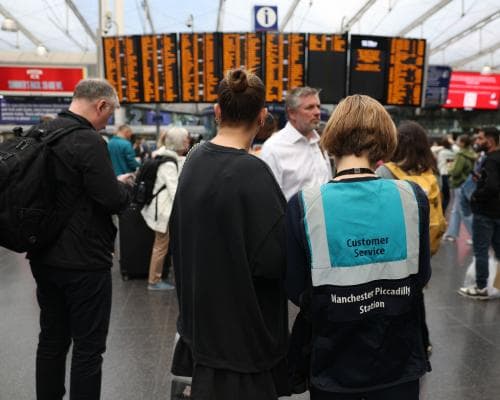
There is a particular kind of silence that falls over a first-class carriage when the train stops dead between Preston and Lancaster. It is not the silence of patience, but of calculation. The WiFi drops, the espresso turns cold, and the carefully scheduled day—the board meeting, the private viewing, the lunch with the sovereign wealth fund—begins to crumble. This week, that silence descended across the North West of England, as a power outage at the Manchester Rail Operating Centre, the very brain of the region's railway, turned a Thursday afternoon commute into a logistical nightmare. For most, it was an inconvenience. For the truly wealthy, it was a stark reminder that time—their most precious asset—is never truly in their control when you depend on shared infrastructure.
The facts are these: a power cut at the hub that controls signalling for the North West’s rail network brought trains to a halt, affecting operators as grand as Avanti West Coast and as vital as Northern. The “do not travel” alert stretched into Friday morning, with TransPennine Express services still limping back to normal as trains and crew were scattered like chess pieces after an interrupted game. Network Rail’s engineers worked through the night, and Chris Wright, their North West route director, offered the kind of apology that has become grimly familiar: “extremely sorry for the disruption.” But for the man or woman in the back of a chauffeur-driven Bentley, the apology is beside the point. The point is that the railway, that great Victorian monument to industry, has become a lottery. And when you are used to winning, you do not buy a ticket.
Let us consider the craftsmanship of a well-run journey. The precision of a Swiss timepiece, the seamless choreography of a Gulfstream’s departure—these are the standards by which the ultra-wealthy measure their world. A railway system, by contrast, is a miracle of engineering made vulnerable by a single point of failure. The Manchester Rail Operating Centre, a nondescript building humming with the electricity that powers thousands of signals, went dark. And with it, the carefully calibrated ballet of arrivals and departures dissolved into chaos. For the connoisseur of reliability, this is akin to a bespoke tailor missing a buttonhole: a small flaw that unravels the entire garment. The rarity here is not in the train itself, but in the certainty of its arrival. And that certainty, it seems, is a luxury no longer available on the public network.
This week’s chaos is a signal, not just a story. It reveals a fundamental shift in how the upper echelons of society view mobility. The era of the grand rail journey—the Orient Express of the mind, the sleek intercity of the imagination—is giving way to a more pragmatic, fragmented reality. For the wealthy, the question is no longer “which class?” but “which alternative?” The private jet, once reserved for intercontinental hops, is now being considered for the Manchester-to-London corridor. The helicopter, a staple of Gulf commuting, is finding new favour in the grey skies of the North. And the luxury car, with its climate-controlled cabin and the freedom of the open road, has become not just a vehicle but a sanctuary. The power outage did not just delay trains; it accelerated a mindset. It whispered to the very rich that their time is too valuable to be held hostage by a circuit breaker.
What does this portend for the luxury market? It suggests a growing appetite for bespoke mobility solutions—private charters, high-end automotive experiences, and even the revival of the private rail carriage, not as a nostalgic folly but as a practical assertion of sovereignty. The ultra-wealthy are not abandoning travel; they are curating it. They are paying for the one thing the railways cannot guarantee: the absence of surprise. As the engineers of Network Rail continue to reposition their trains and crew, the real movement is happening in the quiet offices of private aviation companies and luxury car dealerships. The disruption is a reminder that in a world of fragile systems, the ultimate status symbol is not a first-class ticket, but the ability to never need one.
For those who still choose to grace the rails, the advice is simple: check before you travel. But for the discerning few, the lesson is deeper. Invest in the infrastructure of your own life. A private charter is not an extravagance; it is an insurance policy against the caprice of the grid. The future of luxury travel is not about speed, but about certainty. And in that, the North West’s power cut has been a most effective, if unintended, salesman.
The Experience
For those who refuse to be at the mercy of the grid, consider a private charter from Manchester to London, or a bespoke chauffeur-driven journey in a Bentley Mulsanne, arriving on your schedule, not the network's.