The Last Hand-Knitter: Astrid Furnival’s Radical Wool Empire
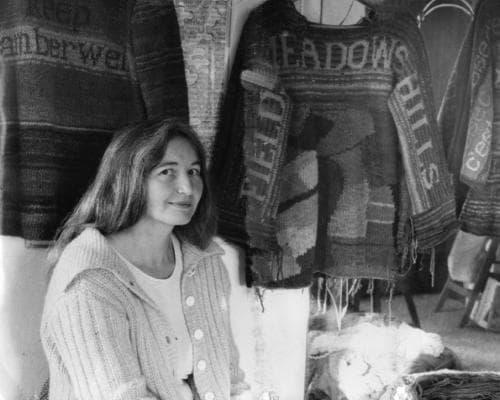
In an age of algorithm-driven design and factory-perfect finishes, one woman refused to let a machine touch her wool. Astrid Furnival spun it herself. She dyed it with plants she grew in her Gloucestershire garden. She knitted by hand, stitch by deliberate stitch, and turned words into wearable art. She died at 85, but her rebellion against the industrial world is a masterclass in what true luxury means: the irreplaceable value of a human hand.
Furnival didn’t just make things. She made objects that think. Her work fused concrete poetry—where the shape of a poem mirrors its meaning—with practical textiles like quilts and knitwear. She called herself a hand-knitter, a term that sounds humble until you realize she spun her own yarn from scratch, using dyes extracted from nettles and flowers in her Nailsworth garden. This was not craft as hobby. This was craft as philosophy, as protest, as a middle finger to the assembly line. Born in Germany in 1939, she was pushed in a pram hundreds of kilometers to safety as the Red Army advanced. That survival instinct never left her. She escaped again to London in 1957 as an au pair, met her husband John Furnival—a friend of David Hockney and Peter Blake—and together they built a creative commune that attracted poets, artists, and musicians. Their group, GLOUP, turned a cottage in the Cotswolds into an epicenter of concrete poetry and visual art.
The numbers don’t matter here. What matters is rarity. Furnival’s pieces are not mass-produced. They cannot be. Each one required months of hand-spinning, dyeing, and knitting. She rejected machines outright—no looms, no power tools, no shortcuts. That kind of labor is almost extinct. In a world where a cashmere sweater from a luxury house costs thousands but is still made in a factory, Furnival’s work is the opposite: one of a kind, slow, and alive. Her inspirations ranged from Dante to Samuel Beckett to the jazz of Roland Kirk. She collaborated with Tom Phillips and Adrian Mitchell. Her pieces sit in archives of concrete and visual poetry, not because they are quaint, but because they are radical. They are textiles that read like poems, poems you can wrap around your shoulders.
What does this signal about wealth today? A shift. The ultra-wealthy are tired of logos. They want provenance, story, soul. A Furnival piece is not something you buy online. It is something you discover in a gallery, at an estate sale, or through a whisper among collectors. It signals that you understand the difference between price and value. That you know craft is the new currency. That you value the artist’s hand over the brand’s stamp. In a market flooded with limited editions, Furnival’s work is truly limited—by the span of one woman’s life and the strength of her hands.
Look ahead. The market for handcrafted, narrative-driven textiles is growing. Collectors are seeking out artists who worked outside the mainstream, who refused to compromise. Furnival’s legacy—her children, her grandchildren, her great-grandchild Frankie—carries that flame. But the real inheritance is the work itself. It reminds us that the most exclusive thing you can own is something no one else can replicate. A Furnival piece is not a product. It is a conversation with a woman who spun her own wool, dyed it with weeds, and knitted poetry into cloth. That is the kind of wealth that never goes out of style.
The Experience
To acquire a Furnival textile, contact specialist galleries in concrete and visual poetry, or attend estate sales of the GLOUP circle. For a curated introduction, inquire with private art advisors who handle post-war British craft.