The $1.5 Million Scissors: Why Yoko Ono’s Cut Piece Is the Ultimate Status Risk for the 0.001%
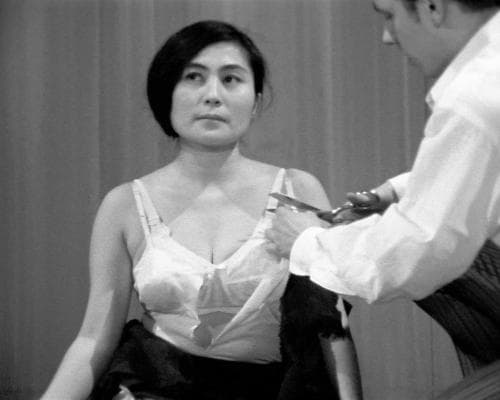
Imagine paying seven figures for a painting, then watching a stranger slice it to ribbons. That is the psychic math behind Yoko Ono’s Cut Piece — and why the world’s most discerning collectors are suddenly booking flights to Los Angeles. On a wall at The Broad museum, black-and-white footage flickers: a 31-year-old Ono sits motionless on a Carnegie Hall stage. Strangers approach, one by one, with a pair of scissors. They cut away her clothing. She does not flinch. The room holds its breath. This is not art you hang above a fireplace. This is art that guts you.
The numbers are simple, but the value is not. Ono’s original 1964 performance has no price tag — it is priceless by definition, an unrepeatable moment in Fluxus history. But the cultural currency is staggering. Cut Piece has inspired Marina Abramović’s endurance works, a Simpsons episode, and countless reinterpretations. Now, as part of the traveling retrospective Yoko Ono: Music of the Mind, The Broad is staging two live performances of Cut Piece on July 17 and 18 at the Redcat theater. The artist MPA — handpicked by Ono’s studio — will sit still while the audience wields the blades. The invitation came with both pride and trepidation. “I’m not scared of having scissors near me,” MPA says. Her real fear: “Can it still have that sting? Or will it just fall back into like a re-enactment?”
Here is the craftsmanship angle the glossy catalogs miss. Cut Piece is not a sculpture you commission or a canvas you acquire. It is a contract of trust written in real time. The instructions never change: the artist sits, the audience cuts. But the context — the year, the city, the strangers in the room — rewrites the work every time. Connor Monahan, director of Ono’s studio, refuses to call these “restagings.” “Every presentation of Cut Piece is a new performance,” he says. “It ultimately becomes a work about the choices people make and how they participate, where they stop, what they hesitate over.” The rarity is not in the object but in the risk: the artist’s body is totally vulnerable to a stranger’s whim. That tension is the luxury. You cannot insure it. You cannot replicate it. You can only witness it.
For the ultra-wealthy, this signals a tectonic shift in taste. The old markers — a Basquiat in the foyer, a Richard Serra in the garden — are becoming predictable. The new status symbol is not owning the art but experiencing the danger. Cut Piece demands something the 1% rarely gives: surrender. You cannot control the outcome. You cannot buy your way out of the discomfort. Sarah Loyer, curator at The Broad, notes that watching the footage in a gallery is a step removed. “In order to convey the full impact,” she says, the museum is staging it live. That is the point. A private jet can get you to the theater, but it cannot protect you from the feeling when the scissors pause at the strap of a bra. That is the commodity now: the unmediated, the unpredictable, the sting.
What does this mean for the market? Expect a quiet arms race for what curators call “participatory provenance.” Collectors who once chased Warhol’s silkscreens will now chase the chance to be in the room when a piece rewires itself. Ono herself performed Cut Piece six times between 1964 and 2003, and each iteration changed her relationship with the work. MPA, through her research, saw a potent vulnerability in Ono’s eyes from the 1964 stills. That vulnerability is the asset. It cannot be faked, forged, or flipped. It can only be lived. For those who miss the live performances, the footage at The Broad remains — but as any connoisseur knows, a recording is a souvenir, not a soul. The real Cut Piece happens once, in a room full of strangers, with a pair of scissors. And you have to be there.
The Experience
Secure your seat at the Redcat theater for the July 17 or 18 performance through The Broad’s concierge desk — private viewing arrangements and post-show dialogues with MPA are available for Patron-level members.