The 14-Hour Miracle: How a 19-Year-Old Rewrote the Rules of Grit and Glory
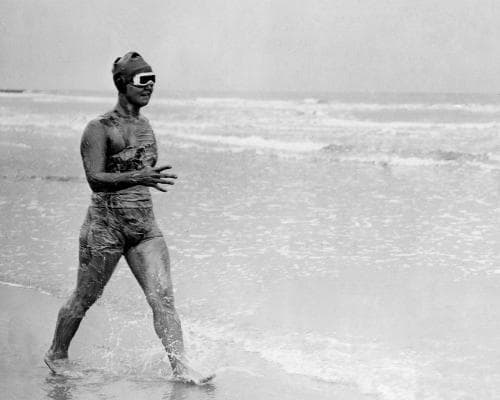
Imagine the cold. Not the chill of a forgotten champagne bucket, but a bone-deep, tide-torn numbness that gnaws at the will. Now imagine facing it for nearly fifteen hours, alone, in a sea that has swallowed stronger men. That is what a 19-year-old from New York did on August 7, 1926. Her name was Gertrude Ederle, and she didn’t just swim the English Channel. She owned it.
Let’s put this in perspective. Before Ederle, only five people had ever crossed the Channel—all men. The record stood at 16 hours and 33 minutes, set by the Italian Tiraboschi in 1923. Ederle, on her second attempt, shaved nearly two hours off that. She finished in 14 hours and 45 minutes. The conditions were brutal: a southwest wind kicked up within an hour of her start from Cape Gris-nez, churning the sea into a rough, gray mess. After six hours, she was still ten miles off the French coast, pushed eastward by currents that turn the course into a giant, inverted Z. The previous best female attempt had fallen just two miles short. Ederle went the distance, and then some.
But this isn’t just a story of numbers. It’s a story of what the ultra-wealthy understand better than anyone: the difference between trying and conquering. The “wiseacres of swimming,” as the papers called them, argued that women lacked the temperament and physique for such ordeals. They cited the numbing chill, the inflammation of the eyes, the sea sickness, the slow accumulation of tribulations that break the spirit. Ederle didn’t argue. She swam. She beat the men under conditions far from ideal, with a rough sea and a tide that forced her to cover far more than the 21 miles as the crow flies—closer to 45 or 60 miles, depending on the drift. She disciplined time and tide, which proverbially wait for no man, and she did it in a wool swimsuit and goggles.
For those who collect rarity, Ederle’s feat is a masterpiece of craftsmanship of the human kind. There is no factory, no atelier, no Swiss movement involved. The raw materials are will, lungs, and a refusal to quit. The price? Unquantifiable. The heritage? Priceless. This is the kind of achievement that defines a dynasty, not a quarter. It signals a shift in what wealth and taste truly mean. In the 1920s, luxury was about acquiring things—yachts, cars, jewels. Ederle reminded the world that the ultimate luxury is the ability to do what no one else can. She turned endurance into a status symbol, and she did it with a grace that made the old guard look foolish.
What does this mean for today’s market? It means that the appetite for the authentic, the genuinely rare, has never been stronger. The ultra-wealthy no longer just want a watch that tells time; they want a story that stops it. Ederle’s swim is that story. It’s a reminder that the best investments are often in human potential, and that the most exclusive club in the world is the one you earn through grit, not a checkbook. As we look forward, the lesson is clear: the next great luxury will not be something you buy. It will be something you become. And if you doubt that, just ask the tide.
The Experience
Book a private consultation with our heritage travel curator to trace Ederle’s route from Cape Gris-nez, complete with a vintage-style swim and a champagne toast on the English shore.