A London Care Home, a Reformist Speech, and the Quiet Luxury of Dignity
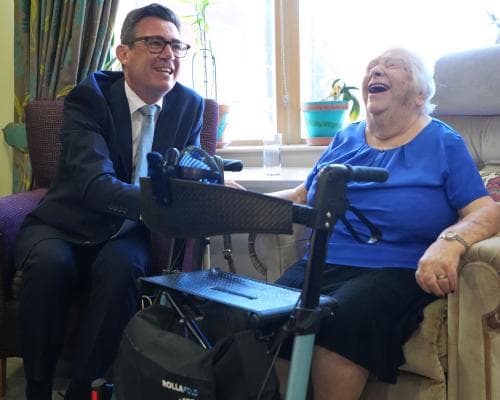
On a grey Wednesday in a quiet corner of north London, the air inside a Jewish care home smelled of tea, polish, and the particular stillness that settles over places built for waiting. Andy Burnham, the Mayor of Greater Manchester and a man who has carried the weight of social care reform like a family heirloom he cannot put down, stood before a modest audience. He was about to make a speech that, by his own admission, he has given before. In 2010, as health and social care secretary, he unveiled sweeping proposals to overhaul England’s creaking adult social care system. They collapsed under the weight of tabloid fury and the spectre of a “death tax”. Now, fifteen years later, he was back. The setting was unglamorous. The subject was anything but. Yet for those who understand that the truest luxury is not a thing but a state of being — a life lived with dignity, from first breath to last — this was the most important story in the room.
Burnham’s speech was brisk, partly off-the-cuff, and deliberately light on policy detail. He promised to accelerate Baroness Louise Casey’s review of social care, pushing its recommendations — which had been scheduled for 2028 under Keir Starmer’s timeline — into a far nearer future. The blueprint for a National Care Service, he said, would land within twelve months. He would back Casey “100%”. But when pressed on what that service might look like, he offered only a Zen master’s shrug: it could be “fully fledged or lesser options or something in between”. For the assembled campaigners, many of whom have watched twenty-two official reviews come to nothing in three decades, the fear was palpable. Was this Brave New World or Groundhog Day? Burnham acknowledged the déjà vu. The King’s Fund thinktank calls the issue a “Westminster graveyard of good intentions”. He was standing at its gate, holding a shovel.
What makes this story worthy of the pages of *The Curated Life* is not the politics — it is the object lesson in what true value looks like when stripped of price tags. The care home itself, a modest brick building in a residential street, is not a destination one books for a weekend. There is no spa, no Michelin-starred kitchen, no concierge. Yet for the families who entrust their elders to its care, it represents something far rarer than a suite at Claridge’s: peace of mind. The staff move with a practised gentleness that cannot be taught in a weekend seminar. The rooms are clean but not luxurious. The budget is tight. And that is precisely the point. The ultra-wealthy may build private clinics and hire round-the-clock nurses, but they cannot purchase a systemic safety net. They cannot buy a society that values the care of its oldest members as much as it values the quarterly earnings of its largest corporations. Burnham’s speech was not about tax brackets or waiting lists. It was about a fundamental question: what do we owe one another at the end of the road?
For collectors and connoisseurs, the parallel is instructive. The most coveted objects in any room are rarely the loudest. A Patek Philippe perpetual calendar does not shout; it whispers. A Hermès Birkin is not a bag; it is a legacy of craft, patience, and scarcity. Social care reform is the same. It is not a headline-grabbing policy that promises immediate transformation. It is slow, expensive, unglamorous work. It requires the kind of patience that the wealthy apply to a vineyard or a vintage car restoration. Burnham’s speech acknowledged that the quality of care must improve, that it must work more closely with the NHS, and that the workforce — undervalued, underpaid, often invisible — needs investment and respect. These are not the talking points of a luxury brand. But they are the foundation of a life worth living, at every age.
The market for care is, in its own way, the most exclusive in the world. It is not open to everyone. It is not even open to most. The best care homes in London — the ones with waiting lists measured in years and fees that rival a private school — are a shadow of what a National Care Service might offer. Burnham’s vision, however vague, points toward a system where quality is not a privilege but a right. For the readers of this desk, that is an investment worth watching. Not because it will yield a return in the traditional sense, but because it will yield something rarer: a society where the final chapter is written with grace, not fear.
As Burnham finished his speech and the tea cups were cleared, the room felt neither triumphant nor defeated. It felt, instead, like the beginning of something. The clock had not been reset. It had simply been wound. For those who understand that the most precious asset is time, and that its quality is determined by the care we receive and give, this was not Groundhog Day. It was a quiet, stubborn act of hope. And in a world of fast cars and faster deals, that is the rarest luxury of all.
More in LIFESTYLE