The Gold Standard: How Australia’s 3x3 Wheelchair Basketball Dynasty Redefines Grit and Grace
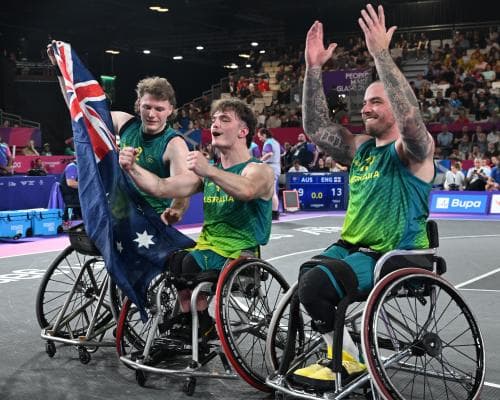
The roar of the crowd was a living thing—a wave of sound that crashed over the court as Eithen Leard sank the final basket. Australia had done it again. Back-to-back gold in 3x3 wheelchair basketball, a discipline that demands more than mere strength. It demands split-second geometry, unbreakable chemistry, and the kind of nerve that polishes pressure into performance. The scoreboard read 19-13, but the story was written in the details: the angle of a pass, the arc of a shot, the way a team moved as one organism.
For the uninitiated, 3x3 wheelchair basketball is the sport’s most distilled form—half the players, double the intensity. Played on a half-court with a 12-second shot clock, it rewards creativity over brute force. Australia’s gold-medal run was a clinic in controlled aggression. Leard, with 10 points, was the fulcrum, but every rotation—every switch and screen—was choreographed like a ballet in carbon fiber. The home crowd, already electric from Scotland’s swimming heroics, found a new reason to stand.
What separates champions from contenders is rarely talent alone. It is the invisible architecture of preparation: the hours in the gym, the data-crunching on opponents’ tendencies, the quiet trust built over years. Australia’s program is a testament to that philosophy. Their athletes train with the same rigor as any Olympic squad, but they carry something extra—a poise that comes from knowing the body is both tool and temple. The wheelchairs themselves are custom-molded, featherlight frames of titanium and aerospace-grade composites, each one a bespoke instrument of motion.
Collectors of rare excellence—whether in art, horology, or sport—understand that true value lies in scarcity and story. This Australian team is a living archive of both. They are not merely athletes; they are artisans of the possible. Their victory in Glasgow was not a fluke but a culmination: a system refined over cycles, a culture that prizes adaptation over ego. England fought valiantly, clawing back to 12-12 with three minutes left, but Australia’s efficiency—their ability to find the open man under duress—was the difference. In the world of high-stakes competition, as in the world of fine acquisitions, consistency is the ultimate sign of pedigree.
Yet what lingers is not the score. It is the way the players celebrated: not with wild abandon, but with a kind of quiet, knowing smile. That is the hallmark of those who have been here before. They understand that gold medals, like rare wines or vintage cars, are not endpoints but chapters. The real prize is the mastery itself—the ability to make the impossible look inevitable. For the ultra-wealthy who collect not objects but experiences, this is the rarest commodity of all: authenticity forged in fire.
As the Commonwealth Games evolve, so too does the definition of luxury. It is no longer just about what you own, but what you witness—the fleeting, perfect moment when human potential becomes poetry. Australia’s 3x3 wheelchair basketball team gave Glasgow that gift. They reminded us that the most valuable things in life cannot be bought. They can only be earned, one pass, one shot, one heartbeat at a time.