The Insect Kingdom’s Greatest Ambassador: Inside Dino J Martins’ Safari of the Small
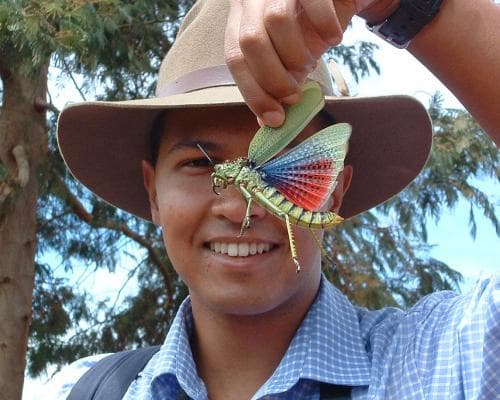
On the plains of western Kenya, where the dust kicks up beneath a Land Rover’s tires and the air smells of wild sage and sunbaked earth, most guests are scanning the horizon for elephants or lions. But Dino J Martins is looking down. He crouches, a grin spreading across his face, and points to a scarab beetle rolling a ball of dung three times its size. “That,” he says, “is one of the most important creatures on the planet.”
For decades, luxury safaris have been defined by the Big Five—the leopards, rhinos, buffalo, elephants, and lions that fill Instagram feeds and lodge coffee tables. But a quieter, more radical shift is underway among the world’s most discerning travelers. They are no longer content to simply observe the charismatic megafauna. They want to understand the architecture of the entire ecosystem—and that means meeting the architects themselves: the insects. Dino J Martins, a renowned entomologist and evolutionary biologist who splits his time between the red earth of East Africa and his research post at Stony Brook University, has become the unlikely Virgil for this new kind of safari. His mission is to champion nature’s villains—the sex-loving hookworms, the parasitic wasps, the army ants—and to show that luxury is not just about rarity, but about revelation.
The experience he offers is not for the faint of heart or the weak of stomach. It begins before dawn on the slopes of Mount Elgon, where Martins spent his childhood with his foster parents, Joe and Sarah Ellen, watching birds and insects in the absence of television. “We had no television, so I learned to look at the creatures around me,” he recalls. Today, he leads small, ultra-private groups—never more than six guests—through Kakamega Forest, the Kerio Valley, and the Maasai Mara, but with a radically different itinerary. Instead of tracking a cheetah, you might find yourself kneeling beside a trail of safari ants, watching their coordinated migration across the plains. Or peering through a macro lens at a male butterfly extracting salt from mud to produce a “nuptial gift” for its mate. Martins narrates these miniature dramas with the warmth of a storyteller and the precision of a scientist, turning the invisible into the unforgettable.
Access is the true currency here. Martins has spent decades earning the trust of local communities and conservation groups; he chairs the insect committee of Nature Kenya and has authored definitive field guides like *Insects of East Africa* and *Butterflies of East Africa*. His network means that guests can step into places no tourist has ever been invited—a farmer’s field where bees pollinate the critically endangered African violet, or a patch of forest floor where a parasitic hookworm’s life cycle plays out in a single square inch. This is not a safari you can book on a website. It is arranged through whispered word-of-mouth among private jet owners and foundation trustees, often as a complement to a traditional luxury camp stay at places like Angama Mara or Cottar’s 1920s Camp. The price is commensurate with the privilege: a bespoke three-day insect immersion starts at roughly $15,000 per person, all-inclusive, with the understanding that you will get dirty, you will be bitten, and you will leave fundamentally changed.
What this signals about luxury travel is profound. For decades, the ultra-wealthy have been able to buy access to anything—except perspective. A private jet can get you to the Serengeti, but it cannot make you see the world through new eyes. Martins offers exactly that: a shift in scale. “Throughout our lives, we are never more than a couple of feet from an insect, yet we ignore them,” he says. The new luxury traveler is not just collecting destinations; they are collecting ways of seeing. They want to understand the systems that underpin the beauty they photograph. They want to know why the dung beetle matters more to the grassland than the lion does. And they are willing to pay a premium for a guide who can show them the invisible infrastructure of life itself.
Where do the wealthy go next? Not to a new country, but to a new dimension. After the pandemic, the most sought-after experiences are those that recalibrate the senses—silence, darkness, intimacy, and the miniature. Martins’ insect safaris are the frontier of that trend. Next season, he plans to launch a “Night of the Parasites” itinerary in the Rift Valley, focusing on the nocturnal lives of moths, glowworms, and the hookworms that have earned their scandalous reputation. For those who have seen everything, this is the last great unseen. It is a reminder that the most luxurious thing in the world is not a suite or a spa, but a story no one else can tell—and a guide who makes you feel like the first person to truly look.