Trump's Vaccine Order Is a Dangerous Experiment in Public Health—and the World Is Watching
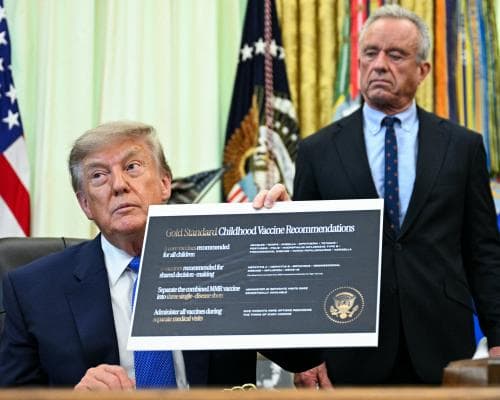
The math is brutal: measles cases in the US are already at a 30-year high, and the president just signed an executive order that will make it harder, not easier, to stop the spread. The directive—which calls for fewer recommended vaccines, breaking the combined MMR shot into separate doses, and spacing out childhood immunizations into separate visits—is a gift to the anti-vaccine movement and a nightmare for pediatricians. Dr. Aaron Milstone of the American Academy of Pediatrics put it plainly: the main outcome will be "confusion for parents," and confusion, in the world of infectious disease, means death.
Let's be clear about what this is not: it is not science. The MMR vaccine is one of the most studied and effective interventions in modern medicine. Splitting it into three shots does not reduce risk—it increases the window of vulnerability between doses. Spacing out vaccines does not make them safer; it just makes them less likely to be completed. The executive order has no immediate legal teeth, but it is a powerful signal to states that they can roll back school-entry vaccine requirements. And it invites litigation against states that keep those requirements in place. The result will be a patchwork of vaccine policies across the US, with the poorest and most vulnerable children paying the price.
The global implications are equally troubling. Ben Kasstan-Dabush, a global health expert at the London School of Hygiene & Tropical Medicine, notes that no country would willingly copy this policy—the outbreak response costs would be astronomical. But ideas travel faster than viruses. The short-term risk is that parents in other countries see the US president questioning the safety of childhood vaccines and conclude that the shots their own governments offer are somehow risky. That is a dangerous illusion, and it will have consequences. Vaccine hesitancy is a global contagion, and it spreads without a passport.
What makes this particularly insidious is the framing. The order is dressed up as "choice" and "informed consent," but it is actually a dismantling of the public health infrastructure that has made childhood vaccination one of the greatest achievements of the 20th century. The US Centers for Disease Control and Prevention (CDC) has recommended the current schedule for decades, based on rigorous clinical trials and real-world data. The executive order is an attempt to override that evidence with ideology. It is a bet that the anti-vaccine base is a more important constituency than the millions of parents who trust their pediatricians.
And here is the kicker: this is not just a US story. The US has long been the global benchmark for vaccine research and regulation. When the FDA or CDC speaks, the world listens. When the president of the United States whispers that vaccines are dangerous, the world hears that too. The order will embolden anti-vaccine movements in Europe, Asia, and Africa, where measles outbreaks are already surging. It will make it harder for public health officials in low-income countries to convince parents that the MMR shot is safe. It will set back years of progress in global immunization coverage.
The irony is that the technology to make vaccines safer, more effective, and more personalized is advancing faster than ever. mRNA platforms that could target multiple pathogens in a single shot are in the pipeline. New adjuvants and delivery systems—microneedle patches, oral drops—could make immunization painless and easier to administer. But these innovations require trust, and trust is what this executive order erodes. The future of vaccines is not fewer shots; it is smarter shots. The future is not fragmentation; it is integration.
So what happens next? The order will face legal challenges, and it may be partially blocked by the courts. But the damage is done. The message has been sent: in the United States, the most powerful man in the world is telling parents to distrust the medical establishment. That message will not stay within US borders. It will travel through social media, through word of mouth, through the whispers of worried mothers and fathers in Lagos, Mumbai, and São Paulo. And when the next measles outbreak hits—and it will—the blame will not be placed on the virus. It will be placed on the policies that let it in.
This is a dangerous experiment, and the world is the lab. The only question is how many children will get sick before we realize the results are in. The data is already clear: vaccines work. The only variable is whether we choose to use them.