The Open's Next Green: How Streaming Giants Are Redrawing Golf's Most Storied Fairways
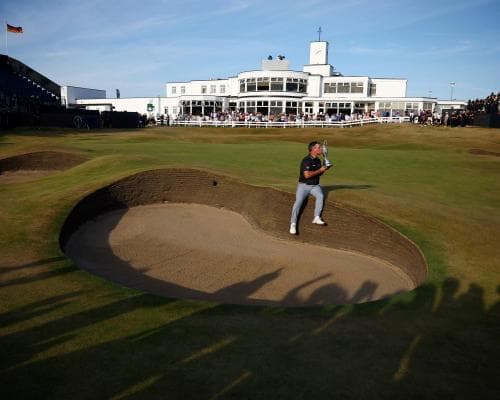
There is a moment at the Old Course when the North Sea wind drops, the gorse goes quiet, and the only sound is the thump of a persimmon driver meeting a ball with a crack that echoes off the R&A clubhouse. That moment—once reserved for the few thousand who could squeeze onto the links, or the lucky souls with a corporate box at the 17th—is about to become the most coveted screen time on the planet. Apple TV, the streaming behemoth that has already lured Formula One and Major League Soccer into its orbit, is now in preliminary talks with the R&A to secure the US broadcast rights to the Open Championship. The current NBC deal, inked in 2017 for a staggering 12 years, expires in 2028, and the formal tender process begins next January. Netflix and Amazon are circling too, but Apple's interest is the one that has the old guard of golf's ruling bodies reaching for a second sherry.
For the uninitiated, the Open is not just a tournament; it is the ancestral home of the sport, a rolling pilgrimage across the British Isles' most dramatic coastline. Think of it as the Wimbledon of golf—except the grass is salt-bleached, the rough is a jungle of heather and bracken, and the weather can turn from benign to biblical in the time it takes to order a pint at the Dunvegan. The R&A, the sport's governing body outside the US and Mexico, has spent the last decade carefully globalising the championship, taking it to Royal Portrush in Northern Ireland and whispering about future stops in Asia. Now, with Apple's $2.5bn MLS misadventure—a deal terminated three years early due to dismal viewership—the tech giant is hungry for a property that carries prestige, not just clicks. The Open, with its 160-year history and its devoted, older, affluent audience, is precisely the kind of trophy that signals taste rather than mere scale.
What would this mean for the traveller who follows the sun and the leaderboard? Imagine settling into a cliffside suite at the Old Course Hotel in St Andrews, the 17th Road Hole below your window, and instead of flipping between grainy cable feeds, you pull up an Apple TV broadcast that feels like a Terrence Malick film—drone shots tracing the dunes, wind microphones capturing the roar of the North Sea, and commentary that treats the sport with the reverence it deserves. Apple's Formula One coverage, which began last year with a five-year, $750m deal, has already set a new benchmark for how motorsport is consumed: no commercial breaks, driver biometrics overlaid in real time, and a pit-lane feed that makes you feel like you're inside the garage. The Open, with its natural drama and its slow-burn tension, is the perfect canvas for that kind of storytelling. It is not hard to imagine a feature where the camera lingers on a player's face as the wind whips the flagstick, or a slow-motion sequence of a ball rolling off the 18th green at Royal Liverpool, the crowd's groan rising like a tide.
But this is not just about pixels and production values. It is about access—the kind that money alone cannot buy, but that a streaming giant can broker. The R&A has been shrewd in its international media rights, keeping the UK broadcast with the BBC and Sky, but the US market is the cash cow. NBC's current deal, shared with the Golf Channel via media company Versant, has been comfortable but safe. Apple, by contrast, brings a global distribution network that reaches into every corner of the world where a private jet can land. For the ultra-wealthy, this means the Open becomes a destination event in a new way. Instead of booking a week in a Scottish castle and hoping for a glimpse of the action, you might find yourself at a private screening party in the Maldives, or on a superyacht anchored off the Isle of Skye, watching the final round on a 120-inch screen while a chef prepares a tasting menu of local scallops and smoked salmon. The R&A's spokesman was diplomatic, praising the incumbent partners while hinting at the future: 'As we look ahead to the next US media cycle, we expect to enter discussions with our incumbent partners and other interested parties.' That is golf-speak for 'the auction is open, and the bids will be eye-watering.'
What does this signal about the state of luxury travel? It confirms that the ultra-rich are no longer content to merely attend events; they want to consume them on their own terms, in their own time, and in the most exquisite settings imaginable. The traditional broadcast model—wake up at 6am, squint at a hotel TV, hope the Wi-Fi holds—is anathema to that lifestyle. Apple, with its seamless ecosystem of devices, its spatial audio, and its 4K HDR, is building a world where the Open is not a broadcast but an experience, streamed directly to a villa in Ibiza or a chalet in Aspen. The MLS failure was a lesson: sports rights are not about volume but about fit. Golf, with its ageing but wealthy demographic, its global reach, and its natural affinity for slow, beautiful television, is a perfect match. The R&A knows this, and so does Apple. The formal tender process will kick off in January, and if Apple wins, expect the price to eclipse the $2.5bn that MLS commanded, because the Open is not just a sport; it is a passport to the most rarefied circles of leisure.
As for where the wealthy go next, the answer is already written in the wind. Scotland's east coast, from Muirfield to Royal Dornoch, is enjoying a renaissance, with new boutique lodges and restored estates catering to those who want to walk the same fairways as Old Tom Morris. But the Open's globalisation means the next stop could be anywhere—a links course in South Korea, a desert layout in the Emirates, or a cliff-top design in Chile. The R&A has been coy about future venues, but the smart money is on a return to the Home of Golf in 2027, followed by a first-ever trip to Asia by the end of the decade. For the traveller, that means the Open is no longer a single week in July; it is a year-round calendar of invitations, each one more exclusive than the last. Whether you watch from the grandstands at St Andrews or from the deck of a 60-metre yacht in the Firth of Forth, the game is changing. And Apple, with its quiet, relentless ambition, is holding the remote.