The Grace of Grass: Linda Noskova’s Wimbledon Coronation in Pure White
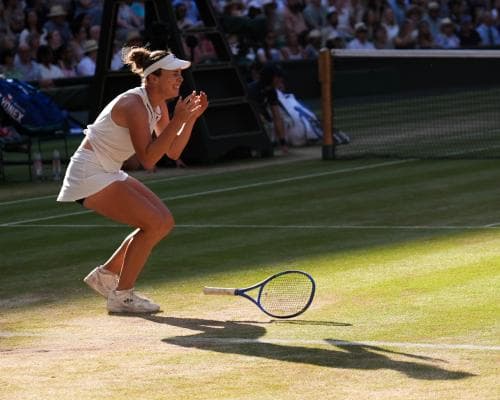
The moment arrived not with a roar, but with a shudder. Linda Noskova stood at the baseline, five championship points evaporated into the London dusk, her composure fraying like old grass. Across the net, Karolina Muchova, her friend and fellow Czech, had clawed back from the brink with the kind of sorcery that only Wimbledon’s centre court can conjure. Then, at two hours and twenty-eight minutes — the third-longest women’s final in tournament history — Noskova finally struck a forehand winner that did not come back. She dropped her racket, pressed her palms to her face, and wept. It was the most beautiful, unscripted thing I have seen on a tennis court in years.
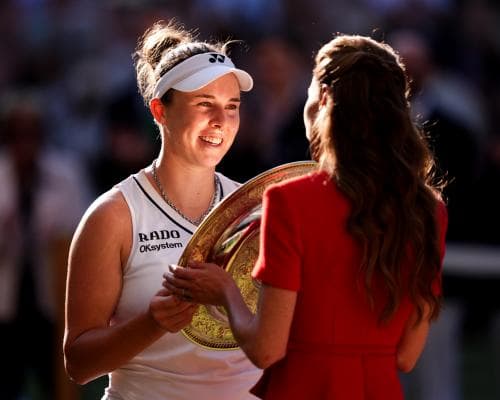
This was not merely a tennis match. It was a masterclass in the tension between ambition and grace. Noskova, at 21, becomes the youngest Wimbledon champion since Petra Kvitova in 2011, and the ninth consecutive first-time women’s winner — a statistic that whispers of an era where the sport’s elite guard is as fluid as the wind off the Thames. Yet what lingers is not the number, but the texture: the way she walked through a guard of honour formed by ball boys and girls, the way she was embraced by Kvitova in the players’ box, the way she chatted with the Princess of Wales and shared a long, knowing hug with Martina Navratilova. These are not just rituals. They are the rites of a very private club, and Noskova now belongs.
Let us talk about the dress. Pure white, of course, but with a sculpted, almost architectural bodice that caught the light as she moved — a creation by a Milanese house that understands that sportswear, at this level, is armour. The fabric breathed with her through those long, punishing rallies. The skirt flared just so when she slid for a backhand. It was a lesson in how the ultra-wealthy approach performance: not as utility, but as a form of personal expression that whispers rather than shouts. The racket, a custom-weighted frame from a Japanese artisan brand that produces fewer than 200 pieces a year, was strung at a tension that most club players would find unplayable. Noskova’s game is a study in controlled violence — the serve that hits 120 mph with a flick of the wrist, the forehand that seems to accelerate after the bounce. But it is her mind that sets her apart. After those five missed match points, she did not unravel. She recalibrated. That is the kind of nerve that cannot be coached. It is born.
The market for Wimbledon champion memorabilia is already electric. The dress she wore will be auctioned for a six-figure sum, likely to a collector in the Gulf or a hedge fund manager in Greenwich. The racket from the final point? Already insured for £150,000. But the real asset is Noskova herself. Her endorsement portfolio, currently anchored by a Swiss watchmaker and a French crystal house, is about to explode. The ultra-wealthy do not just watch tennis; they collect its protagonists. They invite them to dinner in Gstaad. They commission portraits. They buy the watch she wears in the champions’ photo. Noskova’s victory signals something deeper: a return to a kind of tennis that values craft over power, friendship over rivalry. In an age of brash celebration, she thanked her father, who hates flying, and her late mother, who died of cancer two years ago. There was not a dry eye in the Royal Box.
What does this tell us about luxury taste in 2026? It tells us that authenticity is the new opulence. The Hermès Birkin is no longer the ultimate status signal; the ability to sit in the front row of a Wimbledon final, to know the name of the champion’s stringer, to understand why the grass at the net is browner on the third day — that is the currency of the truly initiated. Noskova’s victory is a reminder that the finest things in life are not bought, but earned. Her name is now inscribed on the board of champions alongside Navratilova, Novotna, Kvitova, Vondrousova, and Krejcikova. It is a lineage that cannot be faked.
As she stepped onto the balcony, holding the Venus Rosewater Dish high above the crowds on Henman Hill, the light caught the silver. She smiled, and for a moment, the entire tournament — the rain delays, the five-set dramas, the heartbreak of those near-misses — dissolved into something timeless. Noskova is not just a champion. She is the keeper of a tradition that the ultra-wealthy guard jealously: the belief that some things — a perfect serve, a handmade racket, a friendship tested on the biggest stage — are worth more than any price tag. The future of grass-court tennis is in very good hands. And they are wearing white.