The Silence Before the Roar: Linda Noskova’s Wimbledon Triumph as a Study in Composure Under Fire
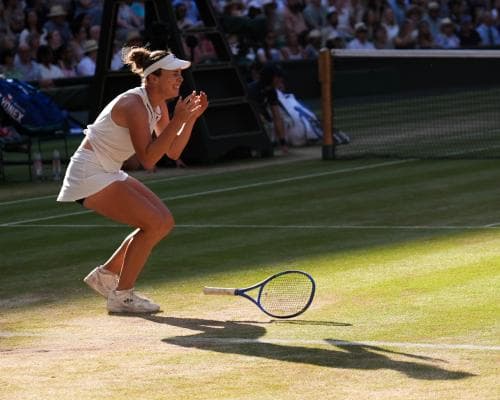
She sat with her fingers in her ears, a 21-year-old trying to block out the roar of 15,000 people who had just watched her fail to convert six match points. It was the kind of silence you can only buy with nerve. Linda Noskova, the ninth seed, had been cruising—6-2, 5-2—when her compatriot Karolina Muchova, the tenth seed, staged a fightback that turned Centre Court into a cauldron of disbelief. The crowd, usually so decorous, erupted not in sympathy but in jubilation at Noskova’s unraveling. And yet, as the final set began, Noskova did something that separates champions from contenders: she stopped listening to the noise and started listening to herself. She won 6-2, 5-7, 6-3, and in doing so, claimed her first grand slam title at the most hallowed address in tennis.
This is not a story about a lucky break or a fluke run. Noskova arrived at Wimbledon having just won the biggest title of her career at the WTA 500 event in Berlin, a warm-up that announced her as a serious threat on grass. Her game is built on first-strike tennis—clean, destructive ball striking that leaves opponents scrambling. Think of it as the tennis equivalent of a perfectly engineered sports car: every movement is precise, every shot intentional. But what makes her compelling is not just the power; it is the poise. In a sport where the margin between victory and defeat is often a single thought, Noskova’s ability to reset after nearly losing a match she had already won is the kind of quiet mastery that attracts collectors of excellence. For those who follow the ultra-wealthy’s taste in athletic pedigree, this is a name to remember.
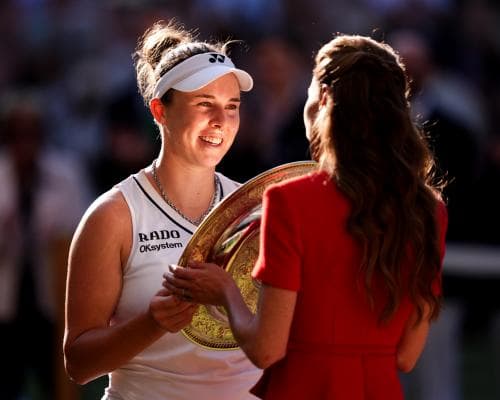
The match itself was a study in contrasts. Muchova, a player of exquisite touch and tactical cunning, refused to yield. She clawed back five consecutive games, turning Noskova’s lead into a final set. The crowd, sensing an upset, shifted its allegiance. But Noskova, who had plugged her ears to block out their cheers, found a deeper reservoir. She broke Muchova’s serve early in the decider and held on with the kind of steely resolve that cannot be coached. It is the same resolve that drives a collector to wait years for a bespoke Hermès Birkin or a limited-edition Patek Philippe. The prize here was not just a trophy—it was the validation of a mindset. The Wimbledon trophy, a gilded silver-gilt cup standing 18.5 inches tall, is worth approximately £50,000 in materials, but its real value is incalculable. For Noskova, it represents entry into an exclusive club where mental fortitude is the only currency that matters.
In the world of luxury, rarity and provenance define value. Noskova’s path to this title is rich in both. She is part of a wave of young Czech talent that has redefined women’s tennis—players like Barbora Krejčíková and Markéta Vondroušová—but Noskova’s game is distinct. She hits harder, moves more fluidly, and, as this final proved, thinks faster under pressure. The market for such talent is voracious. Sponsors, from luxury watchmakers to high-end automotive brands, are already circling. Expect to see Noskova’s face alongside Rolex and Mercedes-Benz in the coming months. For the ultra-wealthy who attend Wimbledon in the Royal Box or the Pimm’s-scented hospitality suites, Noskova is now a name to drop at dinner parties in Gstaad or St. Moritz. She represents not just athletic achievement but a certain kind of cool—the cool of someone who can silence a crowd with a single backhand.
What does this tell us about luxury taste? That the most prized possessions are often invisible. A watch’s movement, a wine’s finish, a tennis player’s composure—these are not things you can buy off a shelf. They are earned through craft, patience, and an almost pathological refusal to quit. Noskova’s victory is a reminder that the best things in life are not the most expensive but the most hard-won. For the readers of The Curated Life, who understand that true luxury is about the story behind the object, this Wimbledon final offers a narrative worth savoring. It is a story of a young woman who, when faced with her worst nightmare, chose to keep her fingers in her ears and her eyes on the prize.
Looking ahead, Noskova’s career is poised to ascend. The women’s game is wide open, with no single dominant figure, and her combination of power and poise makes her a perennial contender. For collectors of sporting moments, the 2025 Wimbledon final will be remembered not for the collapse but for the recovery. It is the kind of story that gets told over a glass of Château Margaux in a private box at Roland Garros or a dinner at The Wolseley. Noskova has not just won a title; she has earned a place in the pantheon of players who understand that the game is never over until the last point is played. And for those who value resilience as the ultimate luxury, that is worth more than any trophy.