The Vending Machine, Reimagined: What the Ultra-Wealthy Would Slot In
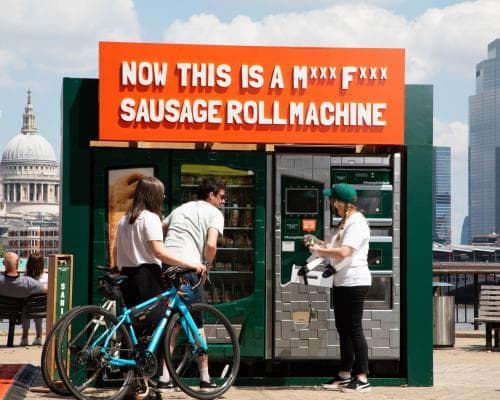
The question arrived with the lightness of a summer breeze: “What do you wish you could buy in vending machines?” Sybil Freestone of Oregon, writing to The Guardian, had heard that in Germany you can buy sausages from a machine — a charming, practical, gloriously unpretentious notion. But for those of us who curate the lives of the very wealthy, the question lands differently. Because for the ultra-rich, a vending machine isn’t a novelty. It’s a challenge.
Imagine, if you will, a machine that dispenses not a Snickers bar, but a key. A key to a Bugatti Chiron, perhaps, or a 1962 Ferrari 250 GTO — the kind of car that doesn’t just turn heads but stops time. The idea isn’t as far-fetched as it sounds. Luxury, at its most refined, is about the thrill of the unexpected, the joy of a serendipitous acquisition. And what could be more serendipitous than pressing B7 and watching a carbon-fiber case slide out, containing a hand-polished key fob and a certificate of provenance, all while you’re waiting for your latte?
Of course, the sausage vending machine in Germany — a beloved institution, dispensing bratwurst and currywurst at all hours — hints at something deeper. It’s about access. The wealthy don’t want to wait for appointments, for private viewings, for the slow dance of a bespoke commission. They want the immediate, the curated, the now. So why not a vending machine for rare whiskies? Not the mass-produced single malts, but the silent distilleries, the lost casks, the bottles that never see a shelf. A machine in a members-only club in Mayfair could offer a 50-year-old Macallan for £50,000, dispensed in a crystal decanter with a velvet pouch. You’d need a fingerprint, of course, and a credit check — but the experience would be pure theatre.
Then there’s the matter of craftsmanship. The German sausage machine works because the product is robust, consistent, and beloved. Luxury vending would demand the same, but elevated. Imagine a machine that dispenses hand-stitched leather driving gloves from a Milanese atelier, each pair numbered and signed. Or a machine that offers a single, perfect Hermès silk scarf — not the seasonal collection, but a limited-edition pattern from 1974, sourced from a private archive. The machine itself would be a work of art: brushed bronze, soft internal lighting, a gentle hum like a well-tuned engine. It would be an object of desire in its own right, placed in a penthouse lobby or a private jet terminal, not a convenience but a conversation piece.
Collectors would flock to such machines, not for the utility but for the rarity. The market for ultra-luxury goods has always been driven by scarcity, and a vending machine that releases only one item per week — announced via a discreet app notification — would create a frenzy. Think of it as a cross between a Baselworld release and a drop from a hyped streetwear brand, but with a patina of old money. A Rolex Daytona Paul Newman, for instance, could be offered at a price that reflects its auction value — say, $1.2 million — but the machine would only accept a specific cryptocurrency, adding a layer of digital mystique. The transaction would be instantaneous, the provenance blockchain-verified, and the buyer would walk away with a story that no auction house could replicate.
What does this say about the direction of luxury taste? It signals a shift from the static to the kinetic, from the curated shelf to the curated moment. The ultra-wealthy are no longer content to own things; they want to experience the acquisition itself. A vending machine, with its mechanical precision and childlike delight, offers that in spades. It also democratizes, in a perverse way, the act of buying — not by lowering prices, but by removing the velvet rope. Anyone can walk up to a machine. The difference is what they walk away with.
So, Sybil, we thank you for the question. You were thinking of sausages; we were thinking of supercars, rare whisky, and the thrill of the unexpected. The vending machine of the future, for the one percent, won’t be on a street corner. It will be in a private gallery, a penthouse, or a superyacht. It will dispense not snacks, but status — pressed, polished, and ready to be driven away. And if you’re lucky, there might still be a bratwurst in it for the rest of us.