Into the Green: A River Journey Through Colombia's Last Guerrilla Heartland
The river does not whisper here; it hums with a deep, ancient insistence, the sound of water pushing against the hull of a wooden boat that has carried more than passengers. We are hours into the San Juan, deep in Colombia's Pacific department of Chocó, where the canopy closes overhead like a green cathedral and the air is so thick with humidity that breathing feels like a deliberate act. On the banks, a line of wooden shacks on stilts appears and vanishes, each one a small, stubborn testament to life on the edge of a map that most luxury travel itineraries never dare to trace.
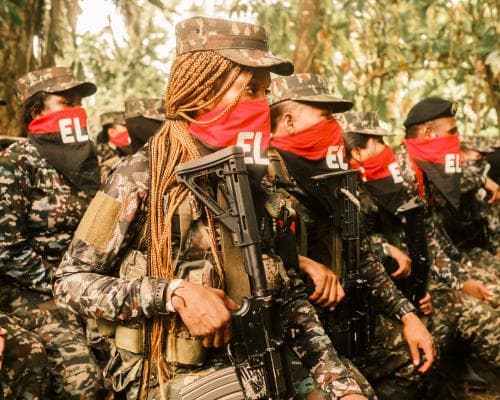
This is not a journey for the faint of heart, nor is it a journey for those seeking the curated comfort of a five-star lodge. It is, however, a journey for the curious — the kind of traveler who understands that the most profound experiences often lie beyond the reach of a concierge. Our boat is a simple pangas, its wooden benches worn smooth by decades of use, and our guide is a quiet man from a nearby village who knows the river's bends the way a sommelier knows the vineyards of Burgundy. He points to a cluster of camouflaged figures emerging from the tree line, and the air shifts. We have entered the territory of the National Liberation Army (ELN), Colombia's last active guerrilla group, a force that has been fighting the state for over six decades.
The commander who calls himself Yerson sits with his rifle across his lap, his face half-hidden in the dim understory. He speaks with a calm that is almost unsettling, discussing the possibility of a new military offensive with the same matter-of-fact tone one might use to discuss the weather. "Where we can go on the offensive, we will," he says, as machetes thwack against bamboo nearby. This is not a performance; it is a declaration of readiness. The ELN has been here for generations, and they have no intention of leaving. For the traveler, this is a rare glimpse into a world that exists in parallel to the glossy brochures of Cartagena or the coffee estates of the Zona Cafetera — a world where the river is both a lifeline and a battlefield.
Further downriver, the landscape shifts. Giant mining barges, their mechanical arms clawing at the riverbed, break the jungle's monotony. They are dredging for gold, and the ELN and rival armed groups — like the Gulf Clan, a violent paramilitary force that stops our boat to question the passengers — are fighting for control of this liquid gold. The river, it turns out, is not just a path; it is a prize. The wealth it carries is not the kind that appears in a portfolio, but it is wealth nonetheless, measured in the grit of sediment and the power it buys. Our guide remains stoic, his hand resting lightly on the boat's tiller, and we move on, leaving the Gulf Clan's armed men to their promises of liberation.
This is the kind of access that money alone cannot buy. It is the result of relationships built over years, of trust earned in whispers and shared silences. For the ultra-wealthy traveler, the appeal is not in the comfort — there is none — but in the authenticity of the encounter. It is the chance to stand at the edge of a story that is still being written, to feel the pulse of a conflict that has shaped a nation for more than half a century. The ELN's camps are hidden from drones, but they are not hidden from those who know how to look, and the river is the only road.
As Colombia's new president, Abelardo de la Espriella, prepares to take office and vows to end peace talks, the region braces for what comes next. For the traveler, this is both a warning and an invitation. The window for such journeys is narrowing, and the river may soon close to outsiders. But for those who manage to slip through, the experience is transformative — a reminder that the world's most compelling destinations are not always the ones on a map. They are the ones that challenge our assumptions, that force us to reconsider what it means to be a visitor, and that leave us with a profound respect for the people who call these places home.
For the luxury traveler, the next frontier is not a new island or a private villa; it is the unscripted, the untamed, the places where the future is uncertain and the present is all that matters. The San Juan River is such a place. It is not for everyone, but for those who seek it, it offers something rarer than gold: a glimpse into the heart of a nation on the brink, and a story that will linger long after the boat has docked.