The $0.00 Inheritance: Why a 63-Year-Old CEO of Self-Reinvention Chose the Barber’s Chair Over the Corner Office
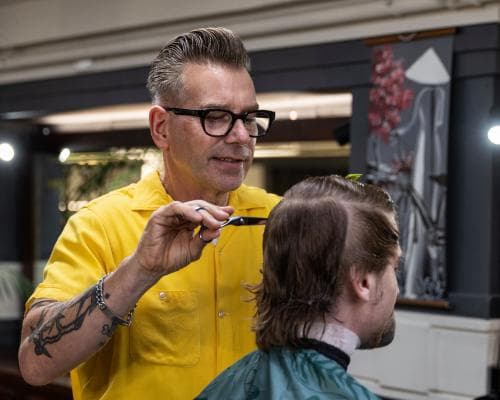
The most expensive thing in the world isn’t a sapphire or a superyacht. It’s permission. Permission to walk away from a six-figure salary, a corner office, and a resume that whispers ‘safe’—and into a life that roars. Phil Yates, 63, knows the price tag. He paid it in full the day he told his father he was leaving marketing to become a barber. His dad, a fishmonger turned factory worker who had slept on the streets as a child, looked at him and said: “That’s fantastic. Life’s so short.” Yates almost cried. That moment, that single sentence of blessing, is worth more than any trust fund.
Yates was 60 when he walked away from a comfortable gig at a software company. He had no haircutting experience. No side hustle. No plan B. He enrolled in a barbering school where most of the other students were 16. “Holy shit, who’s this old man?” was the unspoken question. He didn’t flinch. He swept floors at a high-end Auckland shop called Hava & Co before they even let him near a pair of shears. Now he’s been there ever since. The numbers here aren’t revenue projections or EBITDA margins. They’re hours of humility, ounces of courage, and a lifetime of accumulated taste.
This is not a story about a midlife crisis. It’s about a man who spent decades in graphic design, marketing, photolithography, and box-making—always following whatever sparkled a little brighter—and finally realized that the ultimate luxury is alignment. Yates calls himself “the rocking barber,” a nod to his trademark pompadour and his love of rockabilly music. He curates “cutting playlists” from a 1957 jukebox at home. He hosts an internet radio show called Grits and Grease. His barber chair is not a transaction; it’s a stage. Every snip is a performance. Every client leaves not just with a haircut, but with a story.
What does this signal about wealth and taste? It says that the new status symbol isn’t a watch that costs more than a car. It’s the freedom to choose a craft over a career. It’s the willingness to start at the bottom at an age when most people are planning their retirement villas. Yates still sweeps floors. “Because, hey, I’m here to work,” he says. “Don’t want to sit on my arse looking at a mobile phone.” That’s the kind of ethos that money can’t buy—and that the ultra-wealthy secretly covet. In a world of curated brand identities, authenticity is the rarest commodity. Yates didn’t buy it. He earned it, one floor sweep at a time.
The craftsmanship angle is everything. This isn’t a clip-and-go barbershop. It’s a high-end experience where the owner personally came to Yates’s barber school to watch him work before offering a job. The level 4 certification is the equivalent of a master’s degree in shears. The heritage? Yates’s mother was a hairdresser until she had children. He remembers her giving him a David Bowie Starman cut when he was a teenager. The thread runs deep. The price? Priceless. There is no sticker for a father’s blessing, for a 63-year-old man finding his rhythm, for a jukebox in a home that plays exactly the song you need to hear.
Looking forward, Yates is proof that the second half of life can be the most valuable. He’s not retired. He’s reinvented. For the ultra-wealthy, the lesson is this: the greatest hedge against irrelevance is passion. The market for genuine, unpolished, human connection is only growing. As automation and AI strip away the transactional, what remains is the personal. The barber who knows your name, your music, your story. Yates isn’t building a brand. He’s building a life. And that, in the end, is the only asset that never depreciates.
The Experience
Book a chair at Hava & Co in Auckland and request Phil Yates for a cut that comes with a curated playlist and a story. Or, if you’re ready for your own reinvention, explore barbering certifications that start with sweeping floors.