The Anchor of Eminence: Sam Neill’s Quiet Command of the Screen
The first time you see Sam Neill in a tuxedo, you understand the geometry of power. It is not the flash of a Bond smirk or the heft of a leading man’s swagger. It is something rarer: the quiet certainty of a man who knows exactly where he belongs in the frame. In the 1983 miniseries *Reilly: Ace of Spies*, Neill’s Russian spy Sidney Reilly moves through the drawing rooms of Europe like a blade wrapped in velvet—charming, lethal, and utterly at home in a dinner jacket. This was the performance that made you think: *hot damn, he could have been James Bond*. But Neill never took the 007 slot. He chose something more interesting: a career built on the architecture of support, on the art of making everyone else look brilliant while holding the entire story together.
That talent for anchoring without overshadowing is the hallmark of a true craftsman. In *The Hunt for Red October* (1990), Neill plays Vasily Borodin, second-in-command to Sean Connery’s Captain Ramius. It is a role that could have been swallowed by Connery’s volcanic presence. Instead, Neill gives Borodin a quiet, process-driven dignity. He is the man who keeps the submarine running while the legend makes the grand gesture. There is a lesson here for collectors of anything rare—whether it is a vintage Ferrari or a first-edition Hemingway: the most valuable pieces are often the ones that do not shout. They simply exist, impeccably, in the background, making the whole composition sing.
Then there is the period drama, where Neill’s restraint became a kind of performance art. In *The Tudors* (2007–2010), he played Cardinal Thomas Wolsey, Henry VIII’s most trusted advisor. Wolsey is a man of the cloth who relishes being called “your eminence,” a power broker who prefers to keep his hands clean while others do the dirty work. Neill plays him not as a schemer but as a pragmatist, a man who understands that survival in a court of gold and daggers requires a mask of absolute composure. When Wolsey falls from favor—and he does, inevitably—the actor lets the tragedy flicker behind the cardinal’s eyes without ever letting it flood the screen. It is a masterclass in the performance of power, a reminder that the truly wealthy never show their hand.
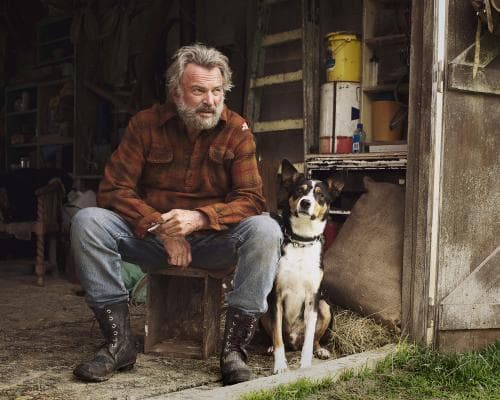
But Neill’s greatest gift may have been his ability to disappear into the landscape. In Warwick Thornton’s *Sweet Country* (2017), one of the finest Australian films of the century, Neill plays a farmer in the brutal outback of the 1920s. The role is lean, weathered, and deeply moral. He does not dominate the frame; he inhabits it, like a gnarled tree that has stood through drought and fire. The film is a neo-western about race, justice, and the unforgiving land, and Neill’s performance is the quiet anchor that keeps the story from drifting into melodrama. It is the kind of work that does not win Oscars but earns something rarer: the respect of those who know how hard it is to make simplicity look effortless.
For the collector of cinematic experiences—the same person who might commission a custom yacht from Lürssen or acquire a Patek Philippe Grandmaster Chime—Sam Neill’s body of work offers a different kind of treasure. It is not about the lead role, the marquee billing, or the red-carpet flash. It is about the craft of being essential without being loud. His performances are like a perfectly tailored suit: they do not draw attention to themselves, but their absence would leave the room feeling incomplete. In an age of algorithmic celebrity and viral fame, Neill’s career is a quiet manifesto for the value of depth over dazzle.
As the news of his passing settles, the world will rightly replay his most famous moments—the dinosaur paddock in *Jurassic Park*, the haunted doctor in *The Piano*, the weary detective in *The Missing*. But the truest measure of his legacy may be found in the roles that never made the poster. The supporting turns that held the picture together. The quiet man in the corner of the frame who made everything else feel real. In luxury, as in cinema, the best things are often the ones you almost do not notice. Sam Neill understood that. He built a career on it. And that, perhaps, is the most refined taste of all.