When the Rain Fails: The Tech Blind Spot in Uganda’s Hunger Crisis
The first bodies were children. Then the elderly. Then the mothers who had given their last handfuls of grain to their sons. By the time Uganda’s government announced emergency food handouts this week, at least 19 people had already died from hunger in the Karamoja region. The official number is almost certainly an undercount. What’s striking is not the tragedy itself — drought-driven famine is an old story in East Africa — but what the response reveals about the tools we have, and the tools we still refuse to deploy.
Karamoja is experiencing its most severe dry spell in years. The last meaningful rain fell in April, the start of the planting season. Crops never germinated. Now, 1.5 million people face acute food shortages. The Famine Early Warning Systems Network (Fews Net), a sophisticated global mapping system that tracks satellite data on vegetation, rainfall, and market prices, flagged the deterioration to crisis level weeks ago. The data was precise. The warning was clear. And yet the only response is a 45-billion-shilling (£9m) emergency allocation approved by parliament to distribute 9,400 tonnes of relief food over two months. That is not innovation. That is triage.
The critical question for anyone tracking how capital and technology shape tomorrow is this: why is a region with known climate volatility still entirely dependent on rain-fed agriculture and post-disaster aid? The answer is a failure of imagination — and a failure of deployment. Precision agriculture, drought-resistant seed engineering, and low-cost irrigation systems have existed for years. But the real game-changer, the one that remains conspicuously absent from Karamoja’s crisis, is robotics and autonomous systems for food resilience.
Imagine a different response. Swarms of small, solar-powered ground robots — already tested in arid zones of Israel and Australia — that can plant, weed, and harvest with minimal water. Drones that map soil moisture at centimetre resolution, then guide targeted drip irrigation to individual plants. Autonomous grain storage units that monitor temperature and humidity to prevent post-harvest loss. These are not science fiction. They are commercially available today. The cost of a single drone-based precision agriculture system has dropped by over 60% in the last five years. The bottleneck is not the tech. It is the absence of a coordinated push from the billionaires and elite capital that claim to want to change the world.
Look at the players. The Gates Foundation has poured millions into drought-tolerant maize for Africa. Jeff Bezos’s Earth Fund has backed satellite monitoring of deforestation. But the robotics-for-food-security space remains oddly underfunded. No major tech billionaire has made it their signature bet. No venture capital firm has built a dedicated fund for autonomous farming systems in the global south. The result is a grotesque asymmetry: we can track a famine in real time from space, but we still send bags of grain on trucks driven by humans over rutted roads.
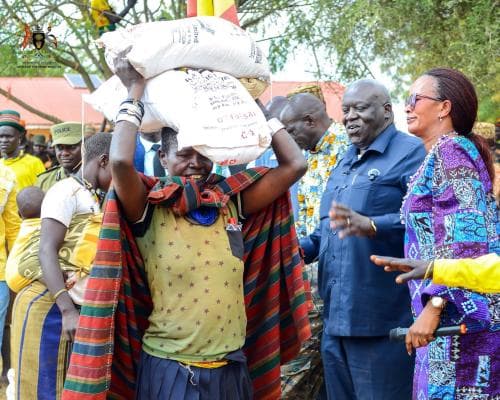
This is not a critique of the Ugandan government. Sam Engola, the minister for disaster preparedness, stood at a primary school in Lodiko sub-county this week and promised that no one would be left behind. He meant it. But his hands are tied by a system that treats food security as a logistics problem rather than a technology deployment challenge. The 45-billion-shilling emergency fund could have bought a fleet of solar-powered autonomous tractors and drip-irrigation kits that would keep producing food for years. Instead, it buys grain that will be gone in two months.
What does this signal for the sector? A massive, unserved market. The global food crisis, accelerated by climate change, is creating demand for resilience technologies at a scale that dwarfs the consumer robotics market. The first billionaire or sovereign wealth fund that treats sub-Saharan Africa not as a charity case but as a robotics deployment zone will capture a generational advantage. The technology is ready. The capital is available. What’s missing is the conviction to bet on machines where the world has always bet on mercy.
Angelina Nakiru, a 21-year-old mother of two in Rupa, now spends her mornings at a small-scale grinding mill, crushing rock into powder to wash out gold flecks. She is trying to buy food with dust. The next time Fews Net sends a warning, the question will be whether we have built the robots to answer it — or whether we will once again count the dead and call it aid.