The Power of the Unseen: Why Anonymity Is the Ultimate Luxury
In an age where every billionaire’s private jet is tracked on Instagram and every CEO’s breakfast is a LinkedIn post, there is one asset that money can’t buy: invisibility. The ability to move through the world without being seen, to create without being known, to speak without being judged—this is the new status symbol. And this week, the art world witnessed a rare, deliberate unmasking that reminds us why the cloak of anonymity remains the most powerful tool in the creative arsenal.
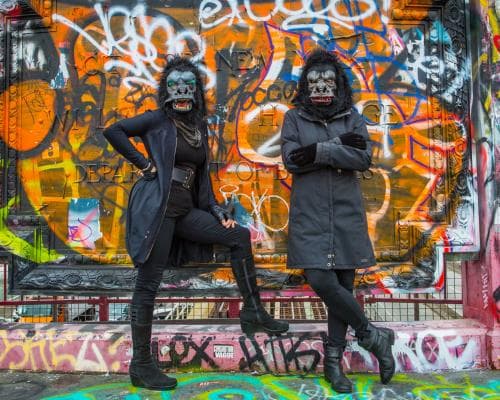
The story begins in 1985, when a group of women in gorilla masks began fly-posting across New York City. They called themselves the Guerrilla Girls, and their posters were sharp, witty, and devastatingly accurate. “Do women have to be naked to get into the Met. Museum?” one famous piece asked. They targeted the art establishment’s glaring gender and racial biases, naming names and shaming institutions. Their masks weren’t just a costume; they were armor. As one founding member later explained, they feared that exposing powerful figures would end their careers. But more importantly, they wanted the focus on the issues, not on their personalities. It was a radical act of self-erasure in a field obsessed with the cult of the individual.
Fast forward to this week, and one of the original Guerrilla Girls, the 83-year-old artist Joyce Kozloff, chose to unmask herself on her own terms. For decades, she operated under the pseudonym Liubov Popova, a nod to the Russian avant-garde painter. Only a handful of identities have ever been revealed, usually posthumously or through legal battles. Kozloff’s decision to step into the light is a rare, deliberate act of narrative control. “I’d had a pact with another Girl that whoever died first, the survivor would bring her out,” she said. “But I suddenly realised that if I were dead, I couldn’t tell the story my way.” It’s a poignant reminder that anonymity is not a prison—it’s a choice, and the ability to choose when and how to reveal oneself is the ultimate privilege.
The Guerrilla Girls are not alone in their embrace of the invisible. Banksy, the world’s most famous anonymous artist, started as a Bristol street artist using an alias to dodge legal trouble. Today, his identity remains a mystery, and that mystery is part of the value. An original Banksy is worth more than the property it defaces, precisely because it comes from nowhere and belongs to everyone. Elena Ferrante, the Italian novelist behind the Neapolitan Quartet, has used pseudonymity to protect her creative space. “Anonymity lets me concentrate exclusively on my writing,” she has said. Even the Secret Barrister, a UK legal blogger, uses anonymity to speak plainly about the justice system without fear of reprisal. These figures understand that in a world of constant exposure, the mask is not a shield—it’s a canvas.
For the ultra-wealthy, this trend is more than a cultural curiosity; it’s a lesson in taste. The luxury market has long been driven by scarcity, but the new scarcity is attention—or rather, the lack of it. When you can buy anything, the one thing you can’t buy is the freedom to be unknown. Collectors who acquire works by anonymous artists are not just buying art; they are buying a piece of that freedom. They are investing in the idea that creation can exist independently of the creator, that value can be intrinsic rather than manufactured by a personality. This is a quiet rebellion against the noise of the modern world, a statement that says: I don’t need to see the face to know the worth.
As the Guerrilla Girls continue their work, now with 55 members having come and gone, their legacy is not just a body of posters but a philosophy. Anonymity is not a rejection of fame; it is a rejection of the terms of fame. It is a refusal to let the market dictate the narrative. And for those who can afford to appreciate it, it is a reminder that true power lies not in being seen, but in choosing when to be seen. In a world that demands constant visibility, the radical act is to turn away. The mask is not a hiding place; it is a throne.
The Experience
For a private viewing of works by anonymous contemporary artists, contact our art advisory desk for an exclusive, invitation-only tour of the year’s most coveted unseen collections.