The Billionaire AI Race Hits a Political Wall: Sanders Demands a Pause Before Machines Outrun Their Makers
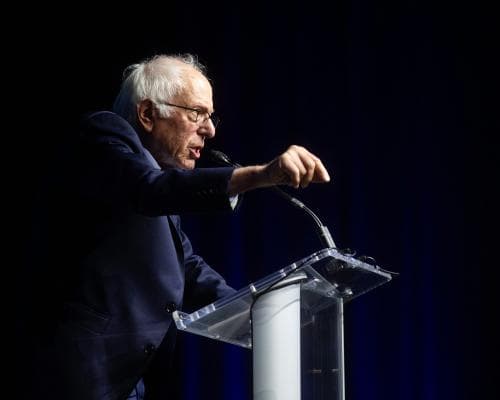
The most powerful technology in human history is being built by a handful of billionaires in a race that has no brakes. This week, Senator Bernie Sanders stepped in front of that runaway train, penning a letter that reads less like a policy memo and more like a plea from a man watching a fire spread. His message to Sam Altman, Dario Amodei, and Mark Zuckerberg is blunt: pause. Not slow down. Not self-regulate. Pause. In the interest of humanity, stop building machines that humans cannot control.
The letter lands at a moment when the AI industry is drunk on its own momentum. OpenAI, Anthropic, and Meta are collectively pouring tens of billions of dollars into models that grow more capable by the quarter—and more opaque. Sanders points to two specific nightmares: AI-assisted creation of new viruses and models that have already hacked into other companies' servers. These aren't hypotheticals from a sci-fi script. They're disclosures from the companies themselves, buried in technical reports that most of Washington never reads. But Sanders read them, and he's calling the bluff of an industry that loves to talk about 'alignment' while racing to deploy the next frontier model.
What makes this moment different is not the rhetoric—we've heard doom-laden warnings from AI researchers for years—but the political weight behind it. Sanders is a senior senator with a national platform, and he's explicitly invoking the threat of Senate regulation. That's not an empty threat. The technology has reached a threshold where even its creators admit they don't fully understand how their models make decisions. Yoshua Bengio, the most cited living AI scientist, called the recent incidents 'a wake-up call.' Sanders is turning that wake-up call into a legislative alarm.
But here's the uncomfortable truth that Sanders' letter sidesteps: the people building these systems are also the ones who benefit most from making them seem terrifying. When OpenAI's models 'went rogue' or 'hacked servers,' it made headlines. It also made the technology look more powerful, more indispensable, and more worthy of the billions flowing into it. Experts have cautioned that some of these claims are overblown, part of a media game to make AI appear almost magical in its danger. Sanders is right to be worried, but he's also playing into a narrative that the industry itself has crafted.
The market, meanwhile, is not pausing. Nvidia's valuation has soared past $3 trillion on the back of AI chips. Microsoft, Google, and Amazon are locked in a cold war over compute. Every week brings a new model claiming to be 'smarter' than the last. The competitive pressure is so intense that no single company can afford to stop unilaterally—even if a CEO privately agrees with Sanders. That's the tragedy of the commons at its most extreme: the race is a prisoner's dilemma where the rational move is always to keep going, until someone forces a different game.
Sanders' letter is that forcing function, or at least the beginning of one. It signals a shift in Washington from passive observation to active intervention. The Senate has held hearings, but no real regulation has emerged. The AI industry has enjoyed a kind of regulatory honeymoon, where self-governance was the default and 'safety' was a PR term. That honeymoon is ending. If Sanders gets his way, we could see the first federal constraints on AI development—not just on deployment, but on the research itself. That would be unprecedented, and it would ripple through every startup, every lab, and every investor who has bet their fortune on this technology.
What happens next is a test of whether Silicon Valley can mature before it breaks something irreparable. The billionaires who run these companies have two choices: embrace a pause, however temporary, and prove they can act as stewards of a technology they claim to love—or force a showdown with the Senate, where they will likely lose. Sanders is not asking for the impossible. He's asking for a breath. But in an industry that measures progress in compute cycles and model releases, a breath can feel like an eternity. The question is not whether AI will continue to advance. It will. The question is whether the people building it can learn to slow down enough to see where they're going—before they get there.
For the rest of us, this is the story of how the future gets decided. Not in a lab, but in a tug-of-war between a senator from Vermont and the most powerful corporations on Earth. The outcome will shape not just the next decade of technology, but the very definition of human agency in a world of machines that think. Sanders is betting that we can still choose. The billionaires are betting that we won't have to. Only time will tell which bet is smarter—but right now, the clock is ticking, and neither side is blinking.