The Billion-Dollar Race to Reengineer Britain's Water Future
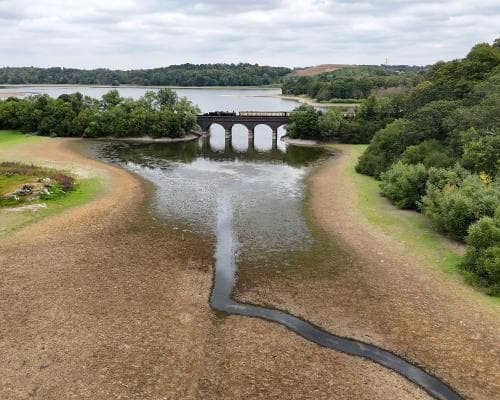
The numbers are stark: July delivered just 7% of the long-term average rainfall, making it the driest month since records began in the 1830s. Three-quarters of England and all of Wales are officially in drought. But the real story isn't the weather—it's the infrastructure. The UK hasn't built a single new reservoir since 1992. While the country's reputation for rain persists, the climate has shifted beneath it, and the water system is still designed for a world that no longer exists.
This is not just a public utility problem anymore. It's a trillion-dollar opportunity for deep-tech innovators, and the world's wealthiest investors are starting to notice. From AI-powered leak detection to atmospheric water harvesting and modular desalination, a new generation of startups is approaching water scarcity as an engineering challenge, not an act of God. The question is no longer whether Britain will run out of water, but whether it will be smart enough to catch up before the taps run dry.
The technology is maturing faster than the policy. Companies like FIDO Tech, a UK-based AI firm, are using machine learning to identify leaks in water networks by analyzing acoustic signatures—saving up to 30% of treated water that would otherwise be lost. Meanwhile, firms like Source Global are commercializing solar-powered panels that extract potable water from air, a technology once dismissed as science fiction. On the desalination front, startups like Desolenator are developing solar-thermal systems that cut energy use by 80% compared to traditional reverse osmosis, making seawater conversion viable for inland and coastal communities alike.
The capital is following the science. Though no billionaire has publicly staked a claim on UK water tech yet, the pattern is unmistakable: Bill Gates has backed water-recycling startups, and Breakthrough Energy Ventures has funded atmospheric water generation. In the UK, the Environment Agency is trialing AI-driven river flow prediction with Imperial College London, and Thames Water—the country's largest utility—has partnered with IBM to deploy predictive analytics across its aging network. The private sector is moving faster than the public one, and that's both a warning and an opportunity.
The market context is brutal but clear. Infrastructure decay is costing billions: the UK loses roughly 3 billion liters of water daily to leaks, enough to fill 1,200 Olympic-sized swimming pools. The regulatory pressure is mounting, with Ofwat threatening fines for utilities that fail to meet leakage targets. But the real driver is climate change. The 2022 drought was the worst in 50 years; this year's flash drought is worse. The Met Office predicts summer rainfall could drop by 20% by 2050, even as demand grows with population and agriculture. The old model of building bigger reservoirs is politically and environmentally untenable—the last one, Carsington, took 20 years to approve.
What's emerging is a new paradigm: water as a data problem. AI can optimize reservoir releases, predict demand spikes, and detect contamination in real time. Smart meters, already rolled out in parts of the UK, generate data that can be fed into machine learning models to identify abnormal usage patterns—catching leaks before they become bursts. The same technology that powers self-driving cars is being repurposed to manage one of the most basic human needs. The sector is set for a Cambrian explosion of innovation, but it needs the right incentives. The current pricing model rewards selling more water, not conserving it. That's starting to change with performance-based regulation, but slowly.
The forward-looking signal is unmistakable: the water crisis is becoming the next great tech battleground. Just as the energy crisis sparked the solar and battery revolution, the drought is catalyzing a similar transformation in water. The UK has a choice—it can continue to patch pipes and hope for rain, or it can embrace a future where every drop is measured, managed, and monetized. The technology exists. The capital is ready. The only question is whether the country's leaders will move fast enough. If they don't, the next drought won't just be a headline—it'll be a permanent fixture of British life. And the billionaires who saw it coming will be the ones selling the solution.
More in INNOVATION