The Art of the Impossible: Sigrid Haugset’s Solo Masterpiece at the Tour de France Femmes
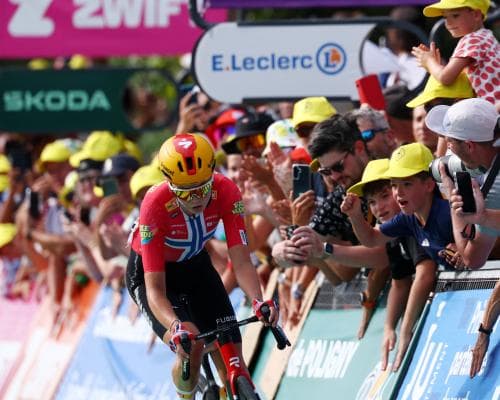
There is a moment in every great race when the peloton’s collective heartbeat falters, and one rider decides to ignore the odds. For Sigrid Haugset, that moment came on stage three of the Tour de France Femmes, and it produced something the cycling world hasn’t seen in years: a solo breakaway of such audacious length that even her own team car seemed to hold its breath. While the sport’s elite — Demi Vollering, Marianne Vos, Lotte Kopecky — sat in the draft, calculating watts and waiting for the inevitable catch, Haugset simply rode away. Not with a sprint, not with a surge, but with a long, grinding, almost meditative effort that would last for hours and end with her arms too weak to lift in celebration.
The 26-year-old Uno-X Mobility rider’s victory was not a product of machinery or marginal gains, though her team’s new aero-optimized Canyon Aeroad CFR certainly played its part. It was a triumph of nerve. For over 100 kilometers, Haugset held a gap that oscillated between 1 minute 20 seconds and a tantalizing 40 seconds, all while the world’s best chased her down with the quiet fury of a pack of thoroughbreds. Kopecky, the reigning world champion, eventually bridged alone, but even she admitted afterward: “I was empty. My legs were starting to cramp and I couldn’t push any more. I had to let her go.” That confession, from a rider who has made a career of absorbing attacks, is the kind of endorsement that money can’t buy. Haugset’s response was even more disarming: “I thought, should I just drop down to her? Second is good! But I kept on.”
This is the stuff of cycling folklore — the kind of ride that gets replayed in team buses for decades. But for the uninitiated, it’s worth understanding what makes it so extraordinary. A solo breakaway in a Grand Tour is not just a physical feat; it’s a psychological siege. Every kilometer, the rider must fight not only the road and the wind but the voice in their head that says the peloton is closing. Haugset’s average speed, reportedly over 40 km/h on a lumpy, technical course, was a masterclass in pacing. Her team car, following inches behind, served as a rolling sanctuary — a mobile support unit that delivered water, gels, and, crucially, the kind of tactical calm that only comes from a well-oiled team. Uno-X Mobility, a Norwegian squad that has been quietly building a reputation for aggressive racing, clearly understood the assignment: when a rider commits, you don’t question it; you protect it.
For collectors and connoisseurs of performance, Haugset’s ride is a reminder that the most valuable assets are often the least quantifiable. The Tour de France Femmes, now in its fourth year, has become a showcase for a new generation of athletes who are rewriting the rules of endurance. The GC standings after stage three read like a who’s who of modern cycling — Vollering, Vos, Ruegg — but Haugset’s name at the top, with a 2-minute lead, is the kind of upset that sends shockwaves through the betting markets and the team boardrooms alike. Her points jersey, too, with 25 points to Kopecky’s 20, signals that this is not a one-day wonder. She is leading the race, and she is doing it with a style that is both humble and ferocious.
What does this mean for the ultra-wealthy who follow the sport from the VIP lounges of the Tour’s hospitality suites? It’s a lesson in the value of the long shot. In a world where everything can be optimized, simulated, and bought, Haugset’s victory is a reminder that the human element — the stubborn refusal to accept the script — remains the most precious commodity. It’s the difference between a limited-edition hypercar and a vintage race car with a patina of battle scars. The former is impressive; the latter is history. Haugset’s ride was history in the making, and those who witnessed it, whether from the roadside or the team car, will remember it long after the jerseys fade.
As the Tour de France Femmes rolls on, the question is not whether Haugset can hold the yellow jersey — though her 2-minute buffer over Le Court and Vollering is a fragile luxury — but whether she can repeat the impossible. She admitted she was “so dizzy at the end” and that her boyfriend will be “angry” she didn’t celebrate. But that’s the thing about the best performances: they’re not for show. They’re for the self. Haugset’s ride was a private victory, shared with the world only through the lens of the TV cameras. For the rest of us, it’s a reminder that the most exquisite things in life — a perfectly aged Bordeaux, a hand-stitched suit, a solo breakaway — are those that cannot be rushed, cannot be bought, and cannot be explained. They simply must be experienced. And if you weren’t watching, you missed something truly rare.