Ukraine’s Rafale Deal Redraws the Map of European Air Power — and Defense Manufacturing
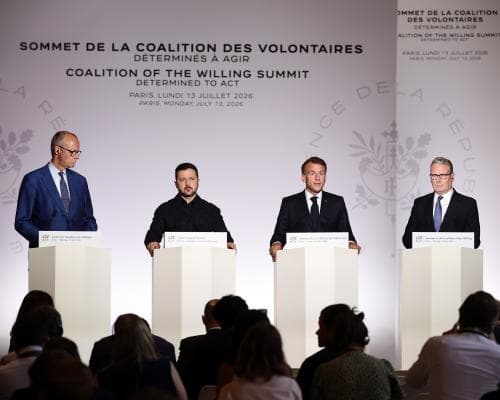
The first 16 Rafale fighter jets won’t take to the skies over Ukraine until 2028 or 2029. That timeline sounds like a lifetime in a war where drones strike by the minute. But look closer: President Emmanuel Macron’s announcement in Paris was not about immediate air cover. It was about a far bigger bet — the first time France has ever licensed full production of its most advanced fighter to a foreign country. Ukraine won’t just fly Rafales. It will build them. This is the future of defense: not just sending weapons, but transplanting entire industrial ecosystems into the theater of conflict.
For years, the playbook for arming an ally was simple: sell or gift finished hardware. Ukraine has received billions in tanks, missiles, and howitzers. But those stocks deplete, and supply lines are vulnerable. Macron’s move changes the math. By licensing production, France is effectively helping Ukraine build its own long-term air force — a sovereign capacity that can ramp up stocks, train local engineers, and eventually export. It’s a model that mirrors what the most forward-thinking private capital is already doing: investing in domestic manufacturing of critical deep-tech hardware, from chips to energy storage to hypersonics. The billionaire class has quietly poured billions into defense tech startups like Anduril and Shield AI. Now governments are following the same logic.
The technology itself is worth unpacking. The Rafale is a 4.5-generation multirole fighter, but its real edge lies in its sensor fusion, electronic warfare suite, and ability to operate from rough airstrips. It’s designed to be networked — a flying command post that can coordinate with drones, satellites, and ground-based radar systems. Macron also confirmed that radar systems are being ceded to Ukraine, which suggests a layered air-defense architecture: Rafales at the top, ground-based radars and missile systems in the middle, and a growing fleet of Ukrainian-made drones at the bottom. This is not just a hardware upgrade. It’s a systems-level redesign of how a country defends its airspace in the age of AI-guided swarms.
The capital story here is equally telling. France’s Dassault Aviation, the Rafale’s manufacturer, is a family-controlled company with deep ties to the French state. But the broader trend is that defense is becoming a magnet for elite capital. Private equity firms like Carlyle and KKR have been snapping up defense suppliers. Venture capital is pouring into autonomous systems, electronic warfare, and hypersonic propulsion. The Rafale deal signals that even traditional defense primes are shifting toward production-sharing models, which lowers political risk and creates long-term revenue streams. For investors, the message is clear: the countries that can manufacture their own advanced weapons will be the ones that survive the next decade’s conflicts.
This also reshapes the competitive landscape. The Rafale competes directly with the American F-35, the Eurofighter Typhoon, and Sweden’s Gripen. But the F-35 comes with strict US export controls and data-sharing restrictions. By offering full production licensing, France is positioning itself as a more sovereign-friendly partner — especially for countries wary of American oversight. Ukraine, now a de facto testbed for Western weapons, becomes a powerful reference customer. If Ukrainian-built Rafales perform in combat, expect a wave of orders from other nations seeking to reduce dependence on Washington. That’s a tectonic shift in the global arms trade.
What does this signal for the broader sector? First, the line between “defense” and “industrial policy” is disappearing. Countries that can build their own chips, jets, and drones will have strategic autonomy. Second, the timeline of war is lengthening. The 2028 delivery date for Rafales suggests that the West is preparing for a decade-long conflict in Ukraine, not a quick resolution. Third, expect more production-licensing deals — for drones, missiles, and even naval vessels. The UK’s simultaneous announcement of sanctions on Russian cyber networks shows that the fight is expanding into digital infrastructure, too.
The forward-looking take: This deal is a blueprint. The next generation of defense will be built on licensed production, local manufacturing, and networked systems that blur the line between aircraft and drone swarms. For billionaires and elite capital, the opportunity is in the factories and software that make this possible — not just in the planes themselves. Ukraine’s skies in 2029 will look radically different. The seeds are being planted now.