The Crown's Quiet Sovereign: Imelda Staunton and the Art of Wearing Power Lightly
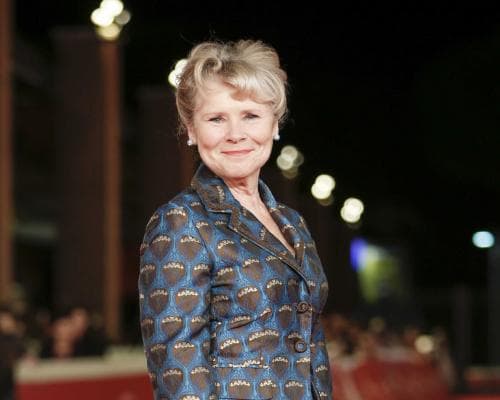
There is a particular kind of power that never raises its voice. It arrives in a cashmere twin set, offers you tea, and then — with the faintest lift of an eyebrow — makes you reconsider every decision you have ever made. That is the power of Imelda Staunton, and it is why her casting as Queen Elizabeth II in the final seasons of The Crown felt less like an actor taking a role and more like a coronation that had been decades in the planning.
Consider the absurdity of her résumé, if you will. She has been the voice of a chicken named Bunty in Chicken Run, the beloved Aunt Lucy in Paddington, and a Welsh miners' strike campaigner in Pride. She has played a lady-in-waiting in Downton Abbey and, most memorably, a Dolores Umbridge whose pink cardigan and simpering smile were somehow more chilling than any Dark Lord's wand. That she can move from animated poultry to the head of the Commonwealth without breaking a sweat is not a sign of inconsistency — it is the mark of a performer who understands that character is not about costume, but about the still, unblinking core beneath it.
That core was forged in the old school. Trained at RADA, Staunton spent six years in repertory theatre before her film debut in Bill Douglas's Comrades in 1986. She did the rounds of British prestige cinema — Peter's Friends, Much Ado About Nothing, Sense and Sensibility, Shakespeare in Love — but it was Mike Leigh's Vera Drake in 2004 that revealed the full depth of her craft. As a warm-hearted cleaner performing illegal abortions in 1950s London, she delivered a performance so interior, so achingly restrained, that it earned her a BAFTA, the Venice Film Festival's best actress prize, and an Oscar nomination. She did not need to shout; she simply let the silence do the work.
That is the same discipline she brings to the Queen, a role that could easily tip into caricature or sentimentality. Instead, Staunton plays Elizabeth as a woman whose entire life has been an exercise in self-erasure — a monarch who learned early that the crown is not a decoration but a weight, and that the only way to bear it is to hold oneself perfectly still. It is a performance of immense subtlety, and it speaks to something the luxury world understands intimately: the most expensive things are rarely the loudest. A hand-stitched suit, a bespoke timepiece, a private jet that looks like a bedroom — these are not statements; they are silences, and they are all the more powerful for it.
For collectors and connoisseurs, Staunton's career is a reminder that rarity is not about the object itself but about the sensibility behind it. In an era of algorithm-driven content and celebrity manufactured for the feed, she represents the old guard: an actor who chose repertory over fame, who took roles because they were interesting, not because they were big. Her guest spot on A Bit of Fry & Laurie, where she was introduced as “Snutty” for reasons known only to Fry and Laurie, is the kind of idiosyncratic choice that money cannot buy. It is the equivalent of a Rothko hanging in a private hallway — not for the public, but for the pleasure of the few who know.
What Staunton signals, then, is a shift in how we value prestige. For years, luxury was about visibility — the louder the logo, the better. But the new guard, the one that quietly buys up vineyards in Burgundy and commissions silent electric hypercars, understands that true status is invisible. It is the ability to walk into a room and command it without a single raised voice. That is Staunton's gift, and it is why her Queen feels so right for this moment. She does not need the crown to be royal; she brings the gravity with her.
As The Crown concludes, Staunton's reign on screen may end, but her influence on the cultural imagination will linger. She has shown us that the most powerful performances — like the most exquisite objects — are the ones that reward patience, that reveal themselves slowly, and that never, ever try too hard. In a world that screams for attention, she whispers, and we lean in. That is the rarest luxury of all.