The Grandest of Gambles: A Curated Tour of Humanity’s Most Audacious Climate Fantasies
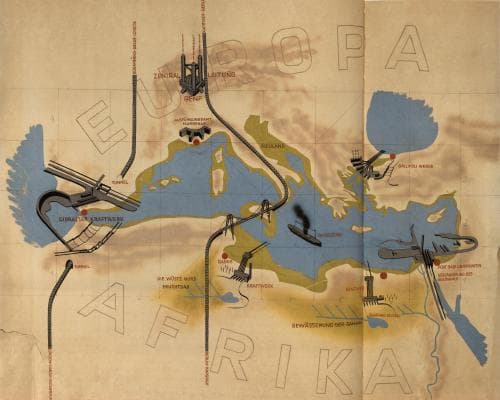
Imagine sipping a Negroni on a private terrace in Venice, only to glance down at canals that have become dry, dusty boulevards. Or boarding a helicopter over Gibraltar to survey a colossal dam, one that has turned the Mediterranean into a fertile basin worked by labourers from Africa. This is not the plot of a dystopian novel. It is Atlantropa—a 1930s vision by German engineer Herman Sörgel that proposed lowering the Mediterranean by two hundred metres to create new land and endless hydroelectricity. For the luxury traveller who has seen everything, from the glacial fjords of Greenland to the private islands of the Maldives, this is the ultimate curiosity: the history of how the world’s most powerful minds once tried to remodel the planet itself.
The story of geoengineering is not new. It is, in fact, the oldest luxury of all: the belief that nature can be bent to human will. Sörgel’s Atlantropa plan survived the Second World War and lingered into the 1960s, championed by leading engineers who designed the great dam with an almost religious fervour. They promised “special measures” to protect Venice’s canals—a detail that reads today like a billionaire’s assurance that a superyacht will not disturb the local ecosystem. The plan was absurd, yes, but it was also a testament to a certain kind of hubris that the ultra-wealthy have always understood: the willingness to spend vast sums on a dream that may never come true.
Then there were the Soviet plans to modify nature. Russians, feeling short-changed by geography, proposed diverting Siberian rivers, seeding clouds with silver iodide, and even building a giant mirror in space to reflect sunlight onto frozen tundra. These were not fringe ideas; they were debated in state planning committees, with budgets that could have funded a small war. Today, those same concepts—cloud brightening, sulphur injection, orbital mirrors—are being resurrected by a new generation of entrepreneurs and governments. The difference? Now the stakes are existential, and the clients are global. The ultra-wealthy are not just buying private jets and carbon offsets; they are funding research into what one might call the ultimate concierge service: planetary climate control.
For the discerning traveller, this is not merely a history lesson. It is a signal of where the world’s most influential minds are turning. The same people who once chartered expeditions to the poles are now investing in geoengineering startups. They attend private briefings in Davos and Aspen, where scientists present models of how to brighten clouds over the Pacific or release sulphur particles into the stratosphere. The price tag for such a venture? Incalculable. But then, luxury has never been about cost; it has been about access to the impossible. The new frontier is not a remote island or a lunar hotel—it is the atmosphere itself.
What does this mean for the way the wealthy travel? It means that the next great journey may not be to a place on a map, but to an idea. Imagine a curated expedition that follows the ghost of Atlantropa: a yacht tour of the Mediterranean’s deepest points, with historians and climatologists on board, discussing what would have happened if the dam had been built. Or a private flight over Siberia, tracing the routes of the diverted rivers that never were. These are not trips for the merely rich; they are for those who understand that the most profound luxury is the ability to shape the world, even if only in conversation.
The most telling detail? That these plans, once dismissed as mad, are now being taken seriously by the very people who can afford to make them happen. The ultra-wealthy have always been drawn to the edge of possibility—whether it is the bottom of the ocean, the summit of Everest, or the silent vacuum of space. Now they are looking at the climate itself as the next great playground. And if history is any guide, they will not be content to simply observe. They will want to build, to alter, to leave their mark on the very air we breathe. For the rest of us, it is a story of breathtaking ambition and chilling consequence. For the luxury traveller, it is the next destination.