The £600 Courier: Why the World’s Elite Are Watching Milton Keynes’ Autonomous Fleet
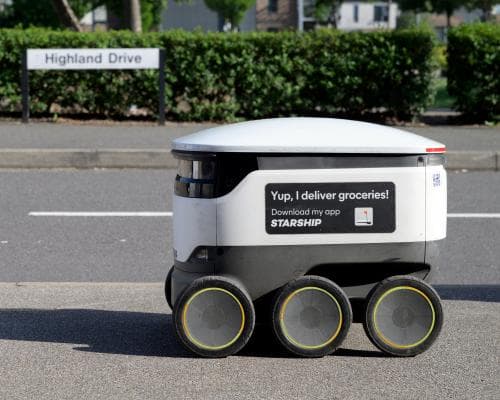
In the rarefied circles where time is the ultimate currency, the mundane chore of collecting a grocery order has long been beneath the dignity of the truly affluent. Yet a quiet revolution is unfolding not in Mayfair or Monaco, but on the geometrically perfect roundabouts of Milton Keynes—a city that, for the discerning observer, has become a living laboratory for a new kind of status signal: the autonomous courier. These six-wheeled robots, dispatched by Starship Technologies, are not merely a novelty for the suburban parent; they are a harbinger of a luxury logistics ecosystem where the very act of acquisition becomes an exercise in frictionless precision. For the billionaire who demands that every minute be optimised, the sight of a robot gliding to one’s doorstep is less a gadget and more a statement of ownership over time itself.
The numbers tell a story of quiet, deliberate expansion. Since 2018, Starship’s fleet has navigated the American-inspired grid of Milton Keynes—a city planned with a postwar audacity that mirrors the ambition of a private jet terminal. Now, the robots have colonised Wakefield, Leeds, and Bristol via Just Eat, with whispers of nationwide approval under new micromobility legislation. But the true metric of their significance lies in the delivery test we conducted: a 7-minute pedestrian journey was compressed to 5 minutes, despite the robot’s cautious, sensor-laden pauses. The machine’s speed is a modest 4 miles per hour, yet its consistency is its luxury. There is no traffic, no driver’s caprice, no human error—only a relentless, algorithmically perfect progress. For the ultra-wealthy, who often measure service in seconds, this is not convenience; it is architecture.
The craftsmanship here is invisible but exacting. Each robot is a composite of radar, cameras, and AI, calibrated to read a pavement like a master tailor reads a bolt of silk. It stops for a mother with a pram, it waits for a child, it navigates a blistering 34°C heatwave without complaint. The price of this unit—approximately £600—is negligible to a billionaire, but its value lies in the engineering: a machine that can be deployed in any town, any climate, any regulatory environment, and deliver a Co-op order with the same deference as a butler. The flagpole atop the robot is not decoration; it is a herald of a new class of service where the delivery itself becomes an objet d’art. For Amrita Singh, the project manager who receives these robots at her door, the utility is clear: “It’s a very good gadget for people who are not able to go out.” But for the elite, it is a tool that transforms the mundane into a spectacle of efficiency.
What does this signal about wealth and taste? In a world where the super-rich increasingly seek to curate their environments, the Starship robot represents the ultimate in passive luxury. It is not about ostentation—there are no logos, no leather interiors—but about the quiet elimination of friction. The robot’s arrival at one’s home is a statement that the owner has outsourced not just the labour, but the very act of waiting. This is the same ethos that drives private jet charters and concierge medicine: the belief that time can be bought, and that the most expensive thing one can own is a schedule without interruptions. The robots of Milton Keynes are a proof of concept for a future where every delivery—from a bottle of vintage Champagne to a bespoke suit—arrives with the same silent, unerring precision. It is a taste that values process over product, and that is the highest form of discernment.
Looking ahead, the trajectory is clear. As the UK government signals approval for nationwide deployment, these robots will become the default last-mile courier for the discerning few who can afford to live in the right postcodes. The technology is not yet available for private ownership, but the infrastructure is being laid for a world where your personal fleet of autonomous couriers is as natural as your car collection. The elite will not just use these robots; they will commission them—customised with finishes, prioritised in algorithms, and dispatched from private warehouses. The question is no longer whether the robots work, but who will control the network. For now, the streets of Milton Keynes offer a glimpse of a future where the most exclusive delivery is the one you never see coming, but always arrives exactly on time.
The Experience
To experience the future of personal logistics, contact Starship Technologies for a private demonstration in a city near you, or arrange a bespoke integration with your estate management team.
More in INNOVATION
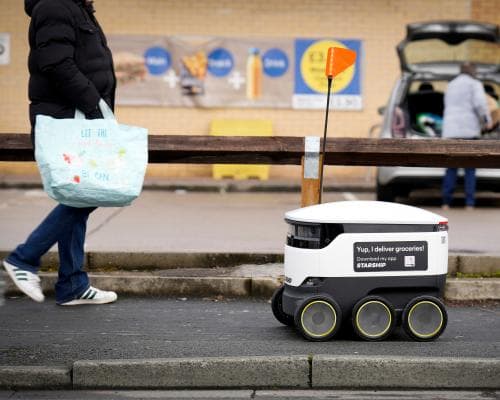
The Autonomous Butler: Why the World’s Elite Are Betting on Pavement-Dominating Robots
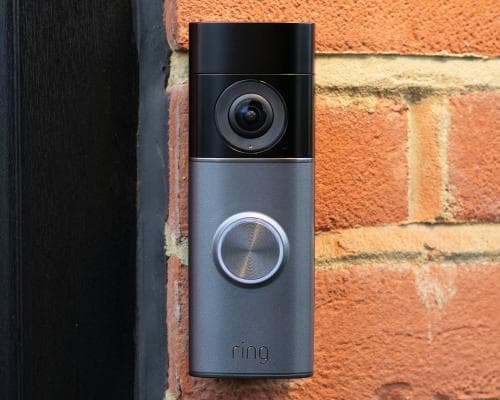
The $250 Door That Sees Everything: Ring’s Pro 3 Rewrites the Rules of Domestic Surveillance

The $1.3 Trillion Exodus: How America’s Community Bankers Are Fighting to Keep Rural Wealth From Vanishing Into Crypto’s Black Hole