The Lovell Telescope's Last Signal: Why the World's Clearest Eyes on the Sky Must Not Be Closed
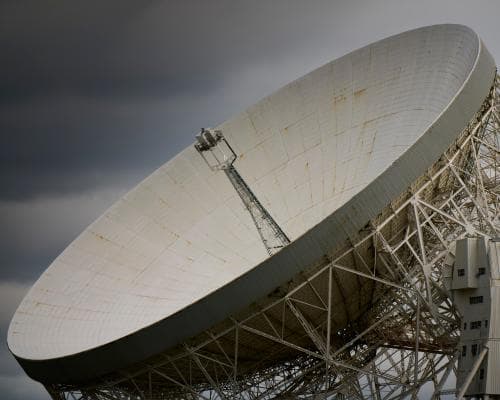
On a clear Cheshire night, the Lovell telescope rises from the farmland like a white cathedral to curiosity. Its 250-foot dish, once the largest steerable radio telescope on Earth, has been tracking whispers from the cosmos since 1957—the year it famously locked onto Sputnik's beeping heartbeat. Now, that whisper is in danger of becoming a final silence. UK Research and Innovation (UKRI) has announced it will withdraw funding for the e-Merlin network, the observatory's national radio astronomy facility, when the current agreement ends in March 2028. The price of saving it? A mere £2.8 million a year—less than the cost of a modest Mayfair flat, or a single evening's charter on a superyacht.
This is not merely a story about a telescope. It is a story about what we, as a civilisation, choose to value. The Lovell telescope is Grade I-listed, a status it shares with Westminster Abbey and the Royal Pavilion. It is the beating heart of Jodrell Bank, a UNESCO World Heritage Site, and the home of e-Merlin, a network of seven radio dishes spread across England that together act as a single, continent-sized eye. That eye has peered into the first billion years of the universe, mapped the formation of galaxies, and studied planets far beyond our solar system. It is, in the words of the poet laureate Simon Armitage, one of 'the world's clearest eyes on the sky'—and the letter he has signed, alongside New Order and Canadian astronaut Chris Hadfield, urges the new prime minister Andy Burnham to keep it open.
For the ultra-wealthy, who often collect rare timepieces or commission bespoke superyachts, the Lovell telescope is the ultimate expression of a different kind of luxury: the luxury of looking outward, of funding the sublime. Consider the craftsmanship. The dish is not a static object; it tilts, rotates, and tracks celestial objects with a precision that would make a Swiss watchmaker blush. Its surface is made of steel panels, each one adjusted to within millimetres, so that the faintest radio waves from a quasar billions of light-years away can be focused into a receiver the size of a dinner plate. The engineering is a masterpiece of mid-century British industrial design, yet it remains state-of-the-art for the science it performs. To shut it down, as the letter states, would be to 'poke out some of the world's clearest eyes on the sky.'
The economics are absurdly modest. UKRI has an annual budget of nearly £10 billion. The £2.8 million required to keep e-Merlin operational is less than 0.03% of that figure—a rounding error in the grand ledger of government spending. Yet the proposed cut would eliminate 28 jobs directly and affect nearly 3,000 researchers who rely on the facility. It is part of a broader rolling package of cuts that could result in about 800 job losses across UK science. For a nation that prides itself on innovation, this is not just shortsighted; it is a self-inflicted wound to its intellectual heritage. The letter, signed by more than 100 artists, writers, and scientists, argues that the closure would be 'foolish'—and they are right.
In the world of collectors, there is a lesson here. The rarest objects are not those with the highest price tags, but those with the deepest provenance. The Lovell telescope tracked Sputnik, the moment humanity first entered the space age. It has listened to the afterglow of the Big Bang. It has been a silent partner in Nobel Prize-winning discoveries. No yacht, no penthouse, no vintage Ferrari can claim such a history. The telescope is a piece of living heritage, and yet it is being treated as a disposable asset. The irony is that the ultra-wealthy often pay millions for a painting by a dead master, but we are willing to let a living instrument of discovery fall silent for the cost of a few private jet flights.
What does this signal about luxury taste in the 21st century? The new luxury is not about possession—it is about preservation. The most discerning collectors are those who fund the things that cannot be replaced: a coral reef, a manuscript, a telescope that still listens to the universe. Jodrell Bank is not a museum piece; it is an active research facility, part of a global project to map the first billion years of cosmic history. To lose it would be to lose a thread in the fabric of human understanding. The letter to Burnham and business secretary Jonathan Reynolds is not just a plea from scientists; it is a call to the nation's conscience. As one astronomer put it, 'We are not asking for a blank cheque. We are asking for the price of a cup of coffee per UK citizen per year.'
The future of Jodrell Bank is, in many ways, a test of our values. If the government can find billions for HS2 and defence contracts, it can find £2.8 million for the stars. The Lovell telescope has survived decades of funding scares, technological shifts, and political whims. It deserves to survive this one too. For those of us who collect experiences rather than objects, who watch the night sky with wonder, and who believe that the greatest luxury is a glimpse of the infinite, the message is simple: write to your MP, support the campaign, and let the Lovell telescope keep its eyes open. Because once the stars go quiet, they do not whisper again.