Europe's wildfires are a climate signal investors can't afford to ignore
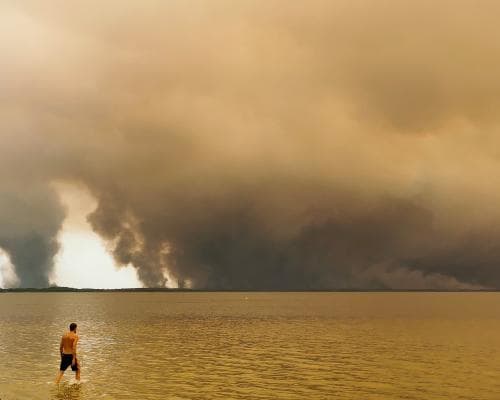
The sun turned blood red over the Atlantic, and the dunes behind the surfers were glowing with an orange tint that felt like the opening scene of a dystopian film. That was Stefan Rahmstorf's view from the water off France's coast last week, as wildfires raged outside Bordeaux. He had spent two decades warning that this would come. He had watched the Elbe flood Dresden in 2002, and the heatwave kill 70,000 Europeans in 2003. He had hoped that each disaster would be the wake-up call that forced the political world to act decisively. Instead, humanity has pumped 750 billion tons of carbon into the atmosphere since then, and the fires are now burning through the cooler Atlantic coast he once thought was safe.
Rahmstorf is not a politician or a venture capitalist. He is a climatologist at the Potsdam Institute for Climate Impact Research, one of the most cited scientists in the field. But his story is a stark reminder that the climate crisis is no longer a distant threat—it is a present, compounding force that is redrawing the map of where people can live, work, and build. For the deep-tech world, this is not just bad news. It is the most powerful market signal we have seen in a generation. The question is no longer whether the climate will change, but how quickly we can adapt to the change that is already locked in.
The fires in Europe are breaking records not just in scale, but in location. The Gironde region in southwestern France has seen more than 20,000 hectares burn in a single week, forcing tens of thousands of evacuations. Spain has lost over 100,000 hectares to wildfires this year alone, according to official data. These are not the fires of the Mediterranean fringe that have always been part of the ecosystem. These are fires in temperate zones, in places that were once considered safe from the worst of climate breakdown. The heat that drove them—temperatures above 40°C in parts of France and the UK for the first time in recorded history—is not an anomaly. It is the new baseline, and it is rising faster than most models predicted.
For investors and innovators, this is a moment of brutal clarity. The technology world has spent the last decade pouring money into renewable energy and electric vehicles, and rightly so. But the fires reveal a gap in that strategy: we have focused on mitigating emissions while neglecting adaptation. The fires, the floods, and the heatwaves are not future scenarios; they are current market conditions. They are creating demand for everything from fire-resistant building materials and smart evacuation systems to satellite-based early warning algorithms and insurance models that can price climate risk in real time. The companies that build these solutions will not be solving a hypothetical problem. They will be solving a problem that is already burning, flooding, and killing people today.
The capital is starting to move. Climate adaptation startups raised a record $1.7 billion in the first half of this year, according to data from PitchBook, up from $1.2 billion in the same period last year. But that is still a fraction of the money flowing into clean energy. The asymmetry is striking: we are spending billions to make the future slightly less bad, while spending trillions to build the infrastructure of the world we want. The fires are a reminder that the world we want cannot be built on a planet that is on fire. Adaptation is not a niche; it is the other half of the climate equation, and it is about to become the center of gravity for a new wave of deep-tech innovation.
Rahmstorf's own story is a lesson in the limits of prediction. He had avoided Mediterranean summers for years because he knew the science. But he did not expect the Atlantic coast to burn. That is the nature of this crisis: it is not linear, and it is not confined to the places we have already written off. The fires are a signal that every coastal region, every forest, every city is now on the front line. The next decade will be defined not by whether we can stop the warming—that ship has partly sailed—but by how quickly we can build the tools to live with it. The smart money is already moving. The rest of the world is still watching the sun turn red, wondering when the wake-up call will come.
It has come. The question is whether we are ready to answer it with more than just alarm. The fires in Europe are not a tragedy to be mourned; they are a market signal to be read. The companies that read it correctly will not just survive the next heatwave—they will define the next economy. The rest will be left to watch the sky burn.