Wiebes' Yellow Jersey Is a Lesson in Valuing Every Second
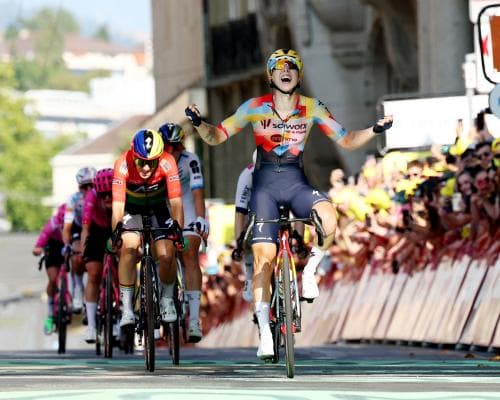
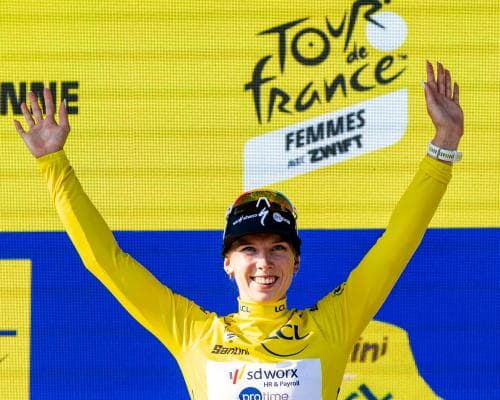
In the high-stakes world of elite cycling, a single second can be worth millions. Lorena Wiebes proved that again on the opening stage of the Tour de France Femmes, out-sprinting race favourites Kim Le Court and Demi Vollering to seize the first yellow jersey. The 27-year-old Dutch sprinter didn't just win a stage—she banked four seconds of overall lead over Le Court and six over Vollering, a margin that could decide the entire race. As sports director Lars Boom put it, "You never know what's going to happen with wildfires in France, so in the end it's always better to get seconds than to have to gain seconds."
For wealth builders, this is a masterclass in the power of incremental gains. The Tour de France Femmes is not just a sporting event; it's a multi-million-dollar commercial ecosystem. Prize money, sponsor bonuses, and future contract values hinge on the final general classification, often decided by seconds. Wiebes' win is a reminder that in any competitive arena—whether markets or bike races—the difference between victory and also-ran is rarely a dramatic leap. It's the accumulation of small, disciplined advantages.
The mechanics of Wiebes' victory were textbook. Her SD Worx-Protime team controlled the race's brutal pace, setting her up perfectly for the Côte Saint-François climb. When Vollering attacked, Wiebes followed, then unleashed a long sprint that no one could match. "The team worked super hard today," she said. "When Demi attacked, I knew I had to follow. It was a long sprint, but I'm super happy." This is not luck; it's preparation, timing, and execution—the same principles that drive successful capital deployment.
But the financial angle goes deeper. Wiebes' win comes months after a bitter setback: she won the opening stage of the Giro d'Italia in May but was disqualified because her bike had an illegal weight. Her team considered legal action against the UCI, cycling's governing body. That incident cost her a likely stage win and the associated prize money and sponsor attention. Yet she bounced back, showing resilience that investors would envy. The lesson? Even when a position is unfairly marked down, the underlying asset—whether a rider or a stock—can recover if the fundamentals are strong.
The race's broader economics are staggering. The Tour de France Femmes has grown rapidly since its 2022 revival, with prize money now matching the men's race at €50,000 for the overall winner. But the real money lies in sponsorships, media rights, and the value of a yellow jersey. A stage win can boost a rider's market value by hundreds of thousands of euros in future contracts. For team owners like SD Worx-Protime, every second saved is a return on investment in training, equipment, and strategy.
Wiebes' lead is slim—just four seconds over Le Court and six over Vollering. Defending champion Pauline Ferrand-Prévot sits ten seconds back, a gap that could close in a single climb. The final outcome will likely be decided by minutes, but as Boom noted, every second counts. This is a direct parallel to investing: a 0.1% fee difference, a tax-efficient structure, or a well-timed rebalancing can compound into life-changing wealth over decades.
Looking ahead, the race's high temperatures and rolling roads are a wildcard. The peloton split after 83km on the Côte de Villars-le-Comte, and breakaway rider Océane Mahé of the lowly Ma Petite Entreprise team took the Queen of the Mountains lead. But with 50km to go, the quartet's advantage dwindled, and the sprinters' teams reeled them in. For Wiebes, the yellow jersey is a target on her back—she'll have to defend it in the coming days. For investors, the takeaway is clear: in any race, whether on the road or in the market, the winner is not always the strongest but the one who values every second and every edge. Wiebes' victory is a reminder that wealth is built not in grand gestures but in the disciplined accumulation of small wins.
More in MONEY
The Sprint Queen's Edge: What Lorena Wiebes' Tour de France Femmes Opener Reveals About Winning Under Pressure

The Ceuta Break: 50,000 Migrants, a Border Breach, and the Price of Europe's Political Disunity

Trump's Truth API: A $100,000-a-Month Window Into the President's Mind — and a New Era of Market Influence