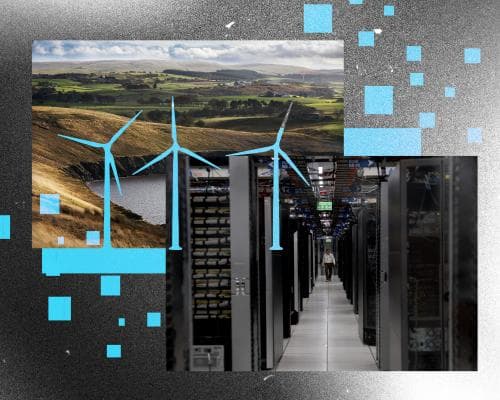
The Billion-Dollar Paradox: Why AI Is Torching Big Tech’s Green Credentials
Picture this: a server farm in the Nevada desert, humming at the volume of a thousand jet engines, consuming enough electricity in a single day to power a small city. That’s the hidden engine behind your next AI-generated email. And it’s the reason the world’s most valuable companies are quietly tearing up their climate pledges. For the ultra-wealthy, who have long treated sustainability as a badge of honor—like a Patek Philippe or a solar-powered superyacht—this is the year the mask slipped.
Last week, Google and Amazon released their annual sustainability reports. The numbers were brutal. Google’s total carbon emissions climbed 25% year-over-year. Amazon’s shot up 16%. Microsoft, which will report soon, is expected to show a similar spike—its 2025 report already documented a 23% increase from a 2020 baseline. Meta’s emissions jumped a staggering 64%. The culprit? Artificial intelligence. Specifically, the datacenters that train and run AI models are energy gluttons. They need constant power, round-the-clock cooling, and vast amounts of water. In the race to dominate AI, these companies are building datacenters at a pace that outstrips their renewable energy projects. Google’s own report admitted a “dual challenge”: managing environmental impact while building infrastructure to meet AI demand. Amazon called the path “not a straight line.” That’s corporate code for: we’re burning more fossil fuels than we’d like to admit.
Let’s talk about what this means for the people who own these companies—and the people who buy their products. For the billionaire class, a clean-energy portfolio was once a status symbol. It signaled foresight, responsibility, and taste. But now, the same investors who demanded ESG (environmental, social, and governance) metrics are demanding AI integration. Stock prices depend on it. And AI depends on power—dirty, abundant, cheap power. The result is a paradox: the very technology that promises to optimize everything from supply chains to climate modeling is itself a carbon bomb. The craftsmanship here isn’t in the code; it’s in the infrastructure. A single datacenter can cost $1 billion to build and consume 100 megawatts of electricity—enough to power 80,000 homes. And the most exclusive AI chips, like Nvidia’s H100, are sold out for months, commanding prices that rival a Bugatti. Rarity and heritage? These companies have none in sustainability. Their green legacies are being traded for silicon and speed.
This shift signals something deeper about wealth and taste in 2025. The old guard of luxury—hand-stitched leather, Swiss movements, private islands—was about permanence. The new guard is about velocity. AI is the ultimate expression of that: faster, smarter, more efficient. But it comes with a hidden cost that even the wealthiest can’t outrun. For the ultra-wealthy, the true luxury is no longer a faster algorithm. It’s a guaranteed supply of clean energy. It’s the ability to say, “My data is processed by a net-zero datacenter.” That’s the new Hermès Birkin—rare, expensive, and increasingly impossible to obtain. As one Silicon Valley insider told me, “Everyone wants to be the first to deploy AI. No one wants to be the first to admit it’s cooking the planet.”
So what comes next? The smart money is already moving. Private equity firms are buying up renewable energy startups at record valuations. Hedge funds are shorting companies with weak climate disclosures. And the most discerning billionaires are quietly investing in nuclear fusion and next-generation battery storage—not because they’re tree-huggers, but because they see the writing on the wall. In a world where AI datacenters will consume 10% of global electricity by 2030, the people who control the clean power will control the future. The tech giants will eventually figure it out—they always do. But for now, the most exclusive club in the world isn’t a boardroom or a yacht. It’s a room full of servers, powered by the sun, and owned by someone who saw this coming.
The Experience
To see how the world’s most exclusive datacenters are being built with net-zero ambitions, book a private tour of a next-gen facility through our concierge service—where sustainability meets scale.