The King Returns to His Kingdom: Hamilton’s Silverstone Masterstroke
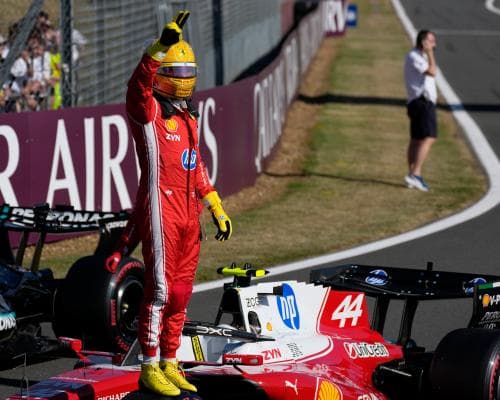
The roar that erupted from the Silverstone grandstands on Friday afternoon wasn’t just noise. It was a release. For the 150,000 spectators who had braved the capricious British summer, Lewis Hamilton’s lap in the sprint qualifying shootout was a masterclass in controlled aggression—the kind of performance that reminds you why some drivers are not merely competitors, but custodians of a track’s soul. Hamilton, now in Ferrari red, had just beaten the Mercedes of Kimi Antonelli by ten milliseconds. Ten milliseconds. That’s less time than it takes for a heart to beat, yet it felt like an eternity of vindication.
This wasn’t supposed to happen. The pundits had whispered that Ferrari would be on the back foot at this power-dominated circuit. Mercedes, with its slippery package, and Red Bull, with its relentless Verstappen, were the favorites. But Hamilton and his SF-24 had other plans. From the moment he rolled out of the garage in first practice, there was a different energy. He topped every session of sprint qualifying, each lap a surgical strike against the narrative. “I love this place, I love this crowd,” he said later, slightly breathless. “I can’t express to you how big a dream it is.” It’s the kind of sentiment that makes you believe in the romance of motorsport again.
What makes this pole so extraordinary is the context. Silverstone is a cathedral of speed—a high-speed ballet of Copse, Maggots, Becketts, and Chapel. It rewards bravery and trust in the car’s rear end. Hamilton, with nine wins here, knows every bump, every kerb, every gust of wind that sneaks across the old airfield. But knowledge alone doesn’t deliver a tenth of a second. That requires a symbiosis between man and machine, a faith in the engineers who dial in the setup, and a willingness to dance on the edge of disaster. “You think about every corner and the flow you can get into if you’ve got the right team behind you,” he reflected. For Ferrari, this is a signal that their resurgence is not just about straight-line speed or clever strategy, but about unlocking the latent talent of a driver who still burns to win.
The market for such moments is, of course, invisible to the casual observer. But in the world of high-end automotive collecting and private track-day investments, Hamilton’s Ferrari affiliation has sent a subtle tremor. The value of his personal collection—which includes a LaFerrari and a 250 GT SWB—has only climbed since his move from Mercedes. More importantly, the cachet of owning a Ferrari that was driven by Hamilton during a competitive weekend is now the stuff of whispered auctions and private sales. It’s not just a car; it’s a time capsule of a particular, defiant moment.
For the luxury traveler or the collector who flies in for a Grand Prix weekend, Silverstone offers an experience that is both rustic and rarefied. The VIP paddock clubs, the champagne-fuelled hospitality suites, the chance to watch a legend recalibrate his legacy—it’s a sensory overload of engineering and emotion. Hamilton’s pole is a reminder that true luxury isn’t about passive comfort; it’s about witnessing excellence in its rawest form. It’s the 0.01-second margin that separates the great from the merely good.
As the sprint race looms, the question isn’t whether Hamilton can convert this pole into a win. It’s whether he can sustain this magic. The championship gap is wide—40 points to Antonelli, 46 to Russell—but Silverstone has always been a place where logic bends to will. For a man who has already achieved everything, this pole is not a consolation. It’s a declaration. And for those of us who watch, it’s a privilege to be in the room when a king reminds his subjects why he wears the crown.