The Grass-Court Salon: Inside Wimbledon’s Most Coveted Courtside Seats
There is a moment, just before the umpire calls ‘play’, when the air on Centre Court holds its breath. The light falls in a particular way across the pristine lawn—the same rye grass that has been tended for centuries—and the crowd, a carefully assembled constellation of hedge-fund heirs, tech founders, and old-money dynasties, settles into their seats. These are not merely seats. They are the most exclusive tickets in sport, passed down through generations or acquired through a ballet of private bankers and Wimbledon’s membership committee. To be here is to own a piece of a ritual that has not changed since 1877, save for the price of the strawberries.
This year, the real drama unfolded not on the show courts but on Court 18, where the 30-year-old former champion Barbora Krejcikova faced her 20-year-old compatriot Nikola Bartunkova. The scoreline—5-5 from 5-2, three match points saved, a final surge of two games—told a story of experience versus youth, but the subtext was about the architecture of the space itself. Court 18 is a theater of intimacy: no retractable roof, no corporate suites, just the raw roar of a crowd that can reach out and touch the baseline. For the ultra-wealthy, this is the holy grail—a seat where the grass is close enough to smell, where the ball’s fuzz leaves a faint green trail in the air. Krejcikova’s victory was a masterclass in composure, the kind of quiet resilience that the best collectors recognize in a fine watch or a rare Bordeaux.
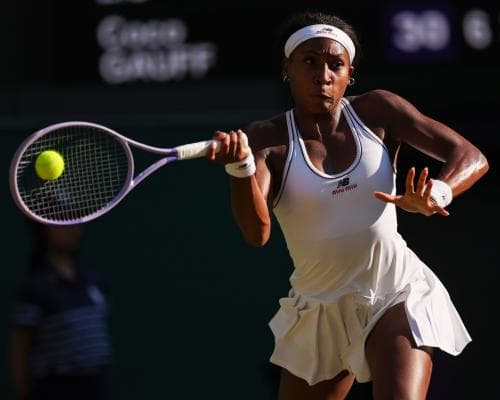
Then came the main event on No. 1 Court: Coco Gauff versus the qualifier Liu, a match that felt like a pendulum swinging between inevitability and chaos. Gauff, with her two Grand Slam titles and a Nike contract that could fund a small nation, held match point not once but three times. Yet Liu, an octopus at the net, refused to yield. She volleyed with the precision of a jeweler setting a diamond, and the crowd—those who had paid tens of thousands for a debenture—leaned forward as one. This is the paradox of Wimbledon: the same spectators who own penthouses in Mayfair and vineyards in Tuscany are, for a few hours, utterly powerless, their wealth irrelevant against the caprice of a drop shot. Sabalenka, watching from the players’ box, later called Liu “a really dangerous opponent,” and her smile was the smile of someone who understands that the best things in life are the ones you cannot buy.
What these matches reveal is a deeper truth about luxury taste in 2026. The old markers—private jets, superyachts, a Birkin in every color—are no longer sufficient. The new currency is access: not just to the event, but to the moment. The debenture holders on Centre Court are not passive observers; they are participants in a centuries-old tradition of patronage. They know that the grass is cut to exactly 8 millimeters, that the umpire’s chair is made from English oak, that the cream for the strawberries comes from a single farm in Kent. This is craftsmanship as ritual, rarity as experience. When Aryna Sabalenka spoke of watching the Nadal documentary and feeling “goosebumps,” she was articulating what every collector knows: the object is nothing without the story.
And so the tournament continues, with Djokovic and Sinner advancing, with Osaka waiting in the wings, and with the quiet hum of the hospitality tents where the Champagne flows like water from a spring in the French Alps. But the real action is in the seats, where a qualifier can topple a champion and a 30-year-old can remind the world that experience has its own grace. For the readers of The Curated Life, Wimbledon is not a sporting event. It is a living gallery, a salon of green and white, where the most valuable asset is not the ticket but the memory of the moment the ball landed exactly where it should not have. That is the ultimate luxury: the thing that cannot be replicated, only witnessed.