The Champs-Élysées Sprint That Rewrote Cycling’s Bloodlines
The heat was biblical. Wildfires licked the edges of the route from Montjuic to Montmartre, and the air shimmered like a mirage over the cobbles. But on the Champs-Élysées, beneath the arc of chestnut trees and the gaze of the Arc de Triomphe, a different kind of fire was burning. Mathieu van der Poel, the Dutch phenomenon with the lineage of a cycling dynasty—his father was a Tour stage winner, his grandfather a legend—had just done something that will be whispered about in private clubs from Gstaad to Gstaad. He broke clear with Tadej Pogacar on the Butte de Montmartre, the brutal final climb, and then, in the last 500 meters, put his head down and willed his bike across the line ahead of a charging pack. The margin? A tyre’s width. The moment? Pure alchemy.
This was the 2026 Tour de France finale, and if you were not watching from a rooftop terrace overlooking the Place de la Concorde, you missed a piece of sporting art. Van der Poel’s victory was not just a sprint; it was a negotiation with fate. He had spent a year dreaming of this moment, he told TNT afterward, while sick and watching from a sofa last season. “I was already thinking about this moment,” he said, his voice still catching. The way he rode—aggressive, intelligent, utterly without fear—was a reminder that the greatest performances in any arena come from a place of personal obsession. For the collector who prizes rarity, this was a one-of-one: a stage win forged in suffering, executed with the cold precision of a Patek Philippe chronograph.
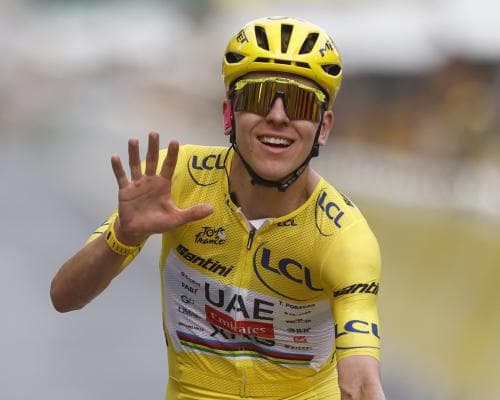
But the real story of the day, the one that will echo through the salons of Monaco and the boardrooms of Geneva, is Tadej Pogacar’s fifth Tour victory. At just 28, the Slovenian has equaled the record of Jacques Anquetil, Eddy Merckx, Bernard Hinault, and Miguel Indurain—the four horsemen of cycling’s apocalypse. Merckx himself, the Cannibal, the greatest ever, said afterward that Pogacar will not stop at five. “He’ll soon break our record,” the 81-year-old Belgian predicted. This is the kind of endorsement that turns a champion into a myth. Pogacar’s dominance this year was absolute: he suffocated the race in the heat, attacked on descents, climbed like a mountain goat on amphetamines, and time-trialled with the metronomic grace of a Swiss movement. His fifth win is not just a number; it is a statement that the old guard’s records are now provisional.
For the ultra-wealthy, the Tour de France has always been more than a bike race. It is a moving theater of endurance, strategy, and taste—the kind of event where the right hospitality tent on the Col de la Loze costs more than a small car, and where the champagne flows as freely as the sweat. But this year, the race also became a mirror for a certain kind of aspiration. The collectors who buy vintage Merckx road bikes at auction, who commission custom Colnagos in carbon fibre, who own shares in professional teams—they saw in Pogacar and van der Poel something they recognize: the relentless pursuit of perfection. Van der Poel’s sprint was a lesson in timing and nerve; Pogacar’s overall victory was a masterclass in consistency and control. These are the same virtues that drive a collector to wait three years for a bespoke Hermès saddle or to bid seven figures on a 1962 Ferrari GTO.
And yet, what sets this moment apart is the sheer improbability of it. Van der Poel is not a pure sprinter; he is a Classics specialist, a rider who wins the Tour of Flanders and Paris-Roubaix on cobbles and mud. To see him outkick the world’s fastest finishers on the Champs-Élysées, after attacking on Montmartre, was like watching a dressage horse win the Kentucky Derby. He did it by trusting his instinct and his legs, and by riding with the best in the world. “I thought we would get pulled back,” he admitted. But they didn’t. And that is the kind of story that the wealthy love to tell over dinner: the tale of the underdog who, through sheer will and a bit of luck, rewrites the script.
What does this mean for the future of luxury taste? It signals a shift away from mere acquisition toward the appreciation of craft and narrative. The new money in cycling is not just in carbon frames and power meters; it is in the stories that attach to them. A bike ridden by Pogacar in the 2026 Tour will soon be a museum piece, its value inflated by the myth of the fifth win. A van der Poel time trial bike, signed and authenticated, will command a premium at auction. The ultra-wealthy are no longer content to buy a Rolex Daytona; they want the one that Paul Newman wore. Similarly, they want the bike that crossed the line on the Champs-Élysées by a tyre’s width. This is the era of provenance, and the Tour de France just delivered a masterpiece.
As the sun set over Paris and the riders rolled toward the team buses, the conversation among those in the know turned to what comes next. Pogacar will almost certainly chase a sixth win, and Merckx’s record of five will fall. Van der Poel, now 31, may never again win a stage on the Champs-Élysées; the moment was too perfect, too singular. But for one evening, in the heat and the dust and the roar of the crowd, two men reminded us why we watch: because sport, at its highest level, is indistinguishable from art. And art, as any collector knows, is the only thing that never depreciates.