A Gymnast’s Quiet Triumph: The Commonwealth Games’ Most Unlikely Estate
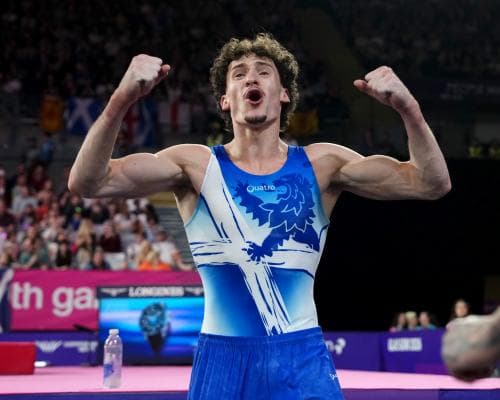
The most coveted seat at the Commonwealth Games this weekend wasn’t in a corporate box or a VIP suite overlooking the pool. It was a modest plastic chair in the Glasgow International Arena, occupied by a young English gymnast named Gabriel Langton. He didn’t compete. He didn’t win. He simply arrived, hobbling on crutches, his leg wrapped in a brace, and sat down to watch his teammates. That moment — captured in a photograph that has since circulated among collectors of rare, unscripted beauty — is the kind of acquisition that money can’t buy. It’s a story of resilience, of quiet triumph, and of the kind of grace that the ultra-wealthy spend fortunes trying to manufacture, yet rarely achieve.
Langton’s journey to that seat began 36 hours earlier, when he suffered a devastating injury during competition. The details are still emerging, but the image is indelible: a young athlete, his dreams of a medal shattered, choosing to be present for his team rather than retreat to a hospital bed. In a world where luxury is often defined by exclusivity and opulence, this is a different kind of rare commodity — vulnerability, courage, and the refusal to let circumstance define one’s narrative. For the discerning collector of life’s finest moments, this is a masterclass in what it means to own one’s story, even when the script goes awry.
The Glasgow International Arena, a venue that typically hosts everything from concerts to trade shows, became an unlikely stage for this human drama. The Commonwealth Games, with its mix of elite athleticism and Commonwealth camaraderie, has long been a gathering place for the world’s most accomplished athletes. But Langton’s appearance shifted the focus from competition to character. His presence, captured by a photographer who understood the weight of the moment, is now being talked about in private clubs and boardrooms as a symbol of something far more valuable than a gold medal: authenticity. In an era where the ultra-wealthy increasingly seek out experiences that feel real, unpolished, and deeply human, Langton’s story is the ultimate luxury asset.
For those who collect moments — the way others collect vintage cars or rare whisky — this is a piece that cannot be replicated. The photograph, which shows Langton’s face a mixture of pain and pride, has been described by one art advisor as “a study in the architecture of resilience.” It is not for sale, of course. But its value is incalculable. The ultra-wealthy have long understood that the most precious things in life are often the ones that cannot be bought: a sunset over the Mediterranean, a child’s first laugh, or the sight of a young man refusing to let his body betray his spirit. Langton’s story is a reminder that the true luxury of the Commonwealth Games is not in the medals or the records, but in the moments that define what it means to be human.
What does this say about luxury taste in 2026? It signals a shift away from the conspicuous — the superyachts, the private jets, the diamond-encrusted watches — toward the meaningful. The collectors who once sought out the rarest Hermès bags are now commissioning portraits of athletes who embody grit. The patrons who funded entire wings of museums are quietly endowing programs that support athletes like Langton, whose stories resonate far beyond the scoreboard. This is the new currency of taste: not what you own, but what you witness. And in that arena, Langton’s hobbled walk to his seat was a gold-medal performance.
As the Games continue, the spotlight will inevitably shift back to the podium and the records. But for those who were there — or who have seen the photograph — Langton’s moment lingers. It is a quiet, unassuming masterpiece, a reminder that the most extraordinary estates are not built of stone and steel, but of moments that cannot be repeated. In a world that often confuses wealth with worth, Gabriel Langton has given us something far more valuable: a story that will be told in the finest drawing rooms for years to come. And that, dear reader, is the truest luxury of all.