The Emir Who Drove His Own Car: Sheikh Hamad bin Khalifa Al Thani’s Unlikely Legacy of Power and Precision
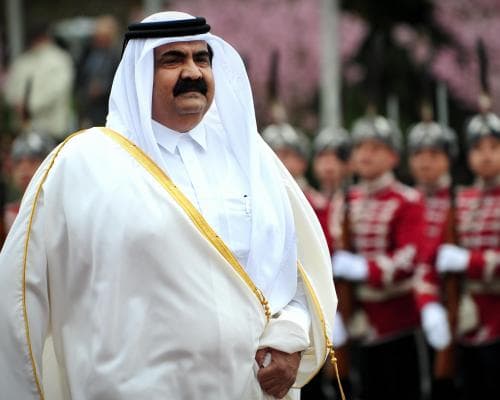
The Swiss lakefront was still, the water lapping softly against the private jetty of a luxury resort in Geneva. Sheikh Khalifa bin Hamad Al Thani, the emir of Qatar, was enjoying a leisurely holiday in June 1995, far from the heat and politics of Doha. What he didn’t know — what no one in his entourage dared whisper — was that his son, Sheikh Hamad bin Khalifa Al Thani, was already moving. In a swift, bloodless operation that would later be studied in boardrooms and intelligence briefings alike, the 43-year-old crown prince declared himself the new emir. No tanks. No gunfire. Just a single, decisive call. It was the most elegant power transfer the Gulf had ever seen, and it set the tone for everything that followed.
Hamad, who has died at 74, was not your father’s emir. He drove his own car through the streets of Doha — a black Mercedes, nothing flashy — and ate at local restaurants with a security detail so minimal you might mistake him for a retired professor. This was not performance. It was a philosophy. Where other Gulf monarchs wrapped themselves in ritualistic finery and maintained an aloof distance from their subjects, Hamad governed like the managing director of a multinational corporation. He was the CEO of Qatar Inc., and his boardroom was a nation. He focused on the big picture — the long arc of history, the shape of the global energy market, the soft power of a sovereign wealth fund — while leaving the daily minutiae to trusted technocrats. A leaked 2008 US embassy cable captured it perfectly: “The Amir seems to be the only one in the Government who has a vision for this country. The details of that vision, however, are not entirely clear to anyone, except perhaps the Amir himself and his closest associates.”
That vision was built on gas. While his neighbors scrambled for oil and squabbled over borders, Hamad bet the house on Qatar’s offshore natural gas reserves — the world’s third-largest. He bypassed the so-called oil curse that had turned other petrostates into cautionary tales, instead channeling the revenue into a sovereign wealth fund that now owns Harrods, the Shard, and a slice of almost every luxury brand you can name. The result was staggering: Qatar became the richest country per capita on the planet, a place where the median citizen could afford a Patek Philippe without blinking. But Hamad’s taste was never about the price tag. It was about the precision. He understood that true luxury is not the gilded object but the quiet mastery behind it — the ability to move without noise, to act without drama, to let the results speak in a whisper.
For collectors and connoisseurs, Hamad’s legacy is a lesson in the value of restraint. In a world of screaming hypercars and diamond-encrusted everything, he proved that the most powerful statement is often the one you don’t make. His personal watch collection, rumored to include a simple Patek Philippe Calatrava and a stainless-steel Rolex Explorer, reflected a man who chose tools over trophies. He didn’t need a tourbillon to tell time; he needed a mechanism that worked, reliably, without fanfare. That ethos — call it functional elegance — is now the holy grail for a new generation of collectors who are quietly selling off their bling in favor of pieces that whisper rather than shout. Hamad was ahead of that curve by two decades.
What does this say about luxury today? It says that the most coveted asset is no longer the rarest gem or the fastest car. It is the story of the person who wore it. Hamad’s story — a coup launched from a Swiss resort, a nation built on a bet, a leader who drove himself to meetings — is worth more than any limited-edition chronograph. It signals a shift in taste among the ultra-wealthy: away from conspicuous consumption and toward what you might call “conspicuous competence.” The new status symbol is not the object but the judgment that selected it. A quiet watch. A personal driver who is you. A vision so clear that it needs no explanation.
As the sun sets on Hamad’s era, the question is what comes next. His son, Sheikh Tamim, now holds the reins, and the sovereign wealth fund continues to acquire everything from London real estate to French vineyards. But the spirit of the founder — the man who fired his father from a Geneva hotel room and then drove himself to dinner — remains the North Star. In a world that increasingly values authenticity over ostentation, Hamad’s legacy is the ultimate collectible: the proof that power, when wielded with precision, needs no crown.