The One-Ton House Guest Tasmania Can’t Stop Adoring
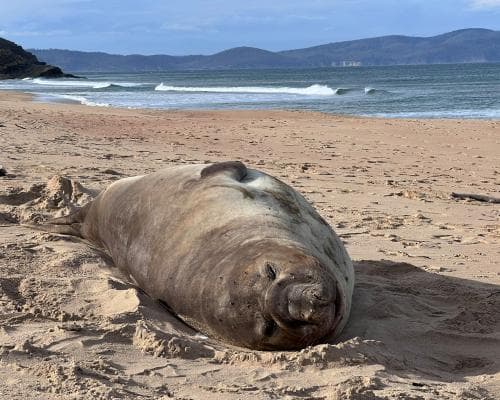
He sleeps in the middle of the road. He headbutts bollards for sport. And when he’s not dozing, he’s play-fighting with the surf. Meet Neil: a one-tonne southern elephant seal who has become Tasmania’s most improbable—and most beloved—house guest. Born on a beach near Hobart in October 2020, Neil keeps coming back to the same stretch of coast, year after year, because he simply doesn’t know any other home. As Dr. Clive McMahon, an elephant seal expert, put it: “He doesn’t have a map.”
For the luxury traveller, Neil represents something increasingly precious: an encounter with the wild that is entirely uncurated. There is no private guide, no exclusive viewing platform, no concierge to manage the moment. Neil returns to southern Tasmania to moult, rest, and practice his sparring—a ritual that, this year, has drawn crowds of admirers who bring their own babies close to the 1,000-kilogram giant for photographs. Wildlife officials have issued an urgent plea: give the seal space. Dr. Kris Carlyon, head of wildlife health for Tasmania’s natural resources department, warns that the public risks “loving Neil to death.”
The danger is real. Neil could eventually reach 3,500 kilograms and stretch 4.5 metres in length. Right now, he’s a massive, placid-looking predator—but as Carlyon notes, “we certainly wouldn’t be approaching polar bears or bison in other parts of the world.” The irony is that Neil’s fame is a double-edged sword: the very adoration that makes him a viral sensation could force authorities to euthanise him if public behaviour becomes unmanageable. For now, he remains a free agent, sleeping on asphalt and ambling through suburban streets as if he owns the place.
What makes Neil’s story so compelling for the discerning traveller is its rarity. Southern elephant seals typically spend their lives thousands of kilometres south, on the subantarctic Macquarie and Heard islands—places so remote that reaching them requires serious expedition planning and a budget to match. Neil, by contrast, chose Tasmania. His presence offers a once-in-a-generation opportunity to observe a wild marine predator up close, without the logistical scaffolding of a charter yacht or a luxury lodge. The price of admission? Patience, a long lens, and a deep respect for the animal’s boundaries.
This is the new frontier of luxury travel: not the curated safari, but the wild encounter that demands humility. The ultra-wealthy have grown tired of staged experiences—the private island where everything is polished, the resort where the wildlife is as predictable as the room service. What they crave now is authenticity, even if it comes with a warning. Neil delivers that in spades. He is not a spectacle to be consumed; he is a force to be witnessed. And if you get too close, you might just learn what it means to be in the presence of something truly untamed.
Where the wealthy go next is not a new hotel or a hidden beach. It’s to places like southern Tasmania, where a seal named Neil reminds us that the best travel stories are not the ones you plan—they are the ones that find you. The challenge, as the Tasmanian authorities know, is to love him without destroying him. For those who can manage that, Neil offers something no five-star resort can: a moment of genuine, unmediated wildness, delivered by a creature who has no idea he’s famous.