Scotland’s Last Secret: The Two-Wheeled Kingdom Where Time Stops
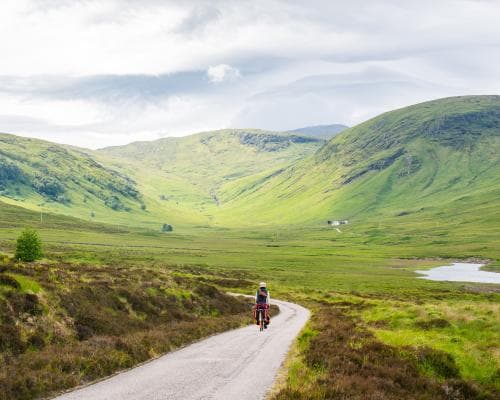
Imagine pulling over on a British road, cooking a full breakfast, and eating it without a single car passing. That’s not a fantasy. It’s a Tuesday morning in Sutherland. While my friend Ben lit the stove, I wandered through the ruins of Dun Dornaigil—an Iron Age broch older than the Roman Empire. Above us, low cloud drifted across the dark cliffs of Ben Hope. That was the moment I knew we had found something the ultra-wealthy spend millions chasing: absolute, unmediated solitude.
Sutherland is the “southern land” of the Vikings, but it feels like the edge of the world. Bare mountains. Impassable peat bogs. One of Britain’s wildest coastlines. This is the most sparsely populated region in all of Europe. Our journey began in Lairg—a hamlet of 800 souls that locals call the “crossroads of the north.” A Spar shop, a hotel, a train station. That’s it. From there, we turned west into Glen Cassley, following a map that promised a dead-end lane dwindling to a 4x4 track. Then, like a secret gift, a ribbon of silky-smooth tarmac appeared—a service road for a hydroelectric dam. It carried us up a steep climb over the top to Loch Shin.
The only way across the next range of hills was an old drovers’ road called the Bealach nam Meirleach—Thief’s Pass. The name hints at cattle rustlers who once used it. Thanks to Scotland’s enlightened access laws, we were free to try it on fully laden touring bikes. It was a boneshaking, thrilling eight-mile ride over genuinely remote hill country, past a string of lochans flanked by glacier-scoured cliffs. Descending into Strathmore, we found the perfect wild-camp spot by the river. Perfect, until the midges appeared. We donned absurd nylon head nets and laughed. That’s the price of a view no hotel can book.
The next day, after our roadside breakfast by the broch, we continued on a narrow road to the tiny hamlet of Altnaharra. The name alone has a romance to it. I’d heard it on winter weather bulletins—the weather station here jointly holds the record for Britain’s coldest temperature: minus 27.2 degrees Celsius in December 1995. A small hotel, originally a 17th-century drovers’ inn, reopened in the 1820s to bring anglers and deer stalkers. It still stands, open from March to October. No Instagram influencers. No motorcades. Just the sound of wind and gravel.
Why does this matter to the ultra-wealthy? Because the North Coast 500 has become the “Instagram highway”—a 516-mile circuit now choked with motorbikes, sports cars, and campervans. Traffic has doubled in a decade. The very definition of exclusivity has shifted. It’s no longer about the most famous road; it’s about the road less traveled, the one that doesn’t appear on any influencer’s feed. Sutherland offers that. It tests life to its limits, but rewards with something rarer than a limited-edition watch: a day when you see no one. When the only engine is your own legs. When the only luxury is the silence.
This isn’t about gear. It’s about access. The real status symbol today is not a supercar—it’s a touring bike, a reliable stove, and the knowledge of where the tarmac turns to gravel. The true connoisseur doesn’t ask for a concierge; they ask for a map. Sutherland’s lost highways are the last great secret of British luxury travel. They won’t stay secret forever. But for now, they belong to those who are willing to pedal, to push, and to sit in the ruins of a 2,000-year-old broch, eating breakfast in the quietest place on earth.
The Experience
Book a bespoke cycling itinerary with Wilderness Scotland, who can arrange custom touring bikes, support vehicles, and wild-camp logistics in Sutherland’s most remote glens.