The Art of the Long Sprint: Demi Vollering’s Masterclass in Controlled Chaos
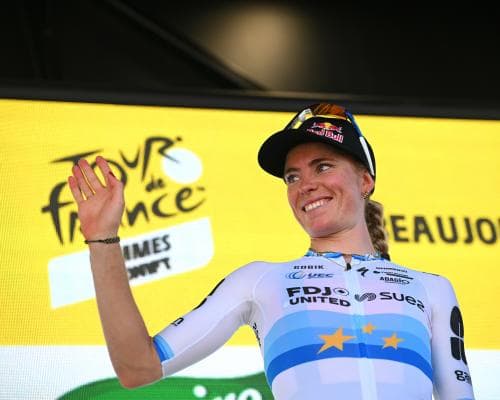
There is a moment in every great race—and every great acquisition—when patience dissolves into instinct. On stage five of the Tour de France Femmes, that moment arrived with 200 meters to go, as Demi Vollering launched herself from the slipstream of her rivals, her face a mask of serene violence. The peloton had spent the day clawing up the Pyrenean foothills, the air thin and the road unforgiving, but the Dutchwoman’s final surge was less a gamble than a declaration. She had read the race like a connoisseur reads a cellar list—knowing exactly when to hold, when to strike, and when to trust that the legs would answer the mind’s call.
For those who follow the women’s peloton, Vollering’s victory was a masterclass in the art of the long sprint—a discipline that rewards not just raw power, but the kind of tactical foresight usually reserved for chess grandmasters. The stage, a rolling, twisting test that shattered the general classification, was won not on the climbs but on the flat, where Vollering timed her run to perfection. As she said afterward, with the breathless honesty of someone who has just danced with uncertainty, “I thought I was not going to make it, but I made it … it was really relief after the finish line.” That relief, that almost-hesitation, is precisely what makes her victory resonate beyond the sport’s hardcore fans. It is the same thrill one feels when a long-coveted piece of art finally arrives—the doubt, the leap, the quiet explosion of joy.
The significance of this win, however, extends far beyond the podium. Vollering’s move to FDJ United-Suez this season was the cycling equivalent of a blue-chip collector switching galleries—a calculated bet on a new environment, a new set of teammates, and a new philosophy of racing. Her stage five performance, delivered in the service of a team that rode with near-telepathic cohesion, was a testament to that gamble paying off. “The whole team, every single rider, was part of it,” she said, and you could hear the genuine warmth in her voice. In an era where cycling’s elite often seem to operate as solo artists, Vollering’s victory was a reminder that the most beautiful wins are often the most collaborative—a lesson that translates effortlessly to the world of high-end collecting, where the best acquisitions are rarely the work of a single eye, but of a trusted network of advisors, restorers, and curators.
For the collectors and connoisseurs who read this page, the finer details of Vollering’s stage—the timing of her attack, the positioning of her lead-out, the final, desperate lunge—are the equivalent of a perfectly executed auction bid. She knew that Kasia Niewiadoma would go early, as she always does, and she let her. She knew that Marlen Reusser might come over the top, and she accepted the risk. In that final straight, she needed every single meter, every millimeter of road, to hold off the charge. It was, by her own admission, a very long sprint—the kind of effort that leaves a rider with nothing in reserve, but everything to show for it. That willingness to spend oneself completely, to risk the collapse for the chance of the crown, is the very essence of what separates the merely great from the truly legendary.
In the broader context of the women’s Tour, stage five was a seismic shift. The general classification was upended, with Vollering’s victory propelling her into contention for the yellow jersey, and the race’s narrative suddenly pivoting from a coronation to a cliffhanger. The crowds that lined the final kilometer, many of them young girls clutching homemade signs, were witnessing history in real time—a moment that will be replayed in highlight reels and remembered in the sport’s oral tradition. For the ultra-wealthy who follow cycling as a lifestyle, this is the kind of drama that money cannot buy, but that a well-placed box seat at the finish line can make feel almost intimate. It is the same thrill that drives the acquisition of a rare Ferrari or a first-edition Patek—not the object itself, but the story it tells, the moment it captures.
Looking ahead, Vollering’s stage five win is more than a single-day triumph; it is a statement of intent. As the Tour de France Femmes continues its ascent into the sport’s mainstream, riders like Vollering are redefining what it means to be a champion—not just in terms of watts and aerodynamics, but in terms of grace under pressure, of tactical intelligence, of the ability to turn chaos into control. For those of us who collect experiences as much as objects, her victory is a reminder that the most coveted prizes are often the ones that demand everything we have, and then ask for a little more. The long sprint is over, but the season is far from done. And if Vollering’s form holds, we may be witnessing the start of a new dynasty—one that will be measured not in seconds, but in the quiet, lasting satisfaction of a race perfectly ridden.