The Baddest Dudes on the Planet: Inside the Springboks’ Unapologetic Reign
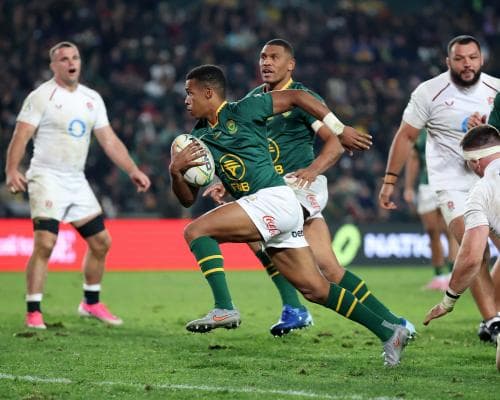
The first thing you notice is the silence. Not the kind that falls after a missed kick, but the hush that descends when a pack of men in green jerseys decides they are done being polite. At Twickenham, with the scoreboard already tilting, South Africa’s forwards began to carry with a deliberate, almost ceremonial violence. England’s defenders folded like napkins. The crowd, a sea of white jerseys, went quiet. Then came the roar—deep, guttural, unmistakably South African. It was the sound of a team that knows exactly what it is: the baddest dudes on the planet.
This was not a game of close calls or lucky bounces. It was a physical audit. South Africa carried 119 times to England’s 118—statistical parity, until you look at the metres made after contact: 324 for the Springboks, 274 for England. Ten line-breaks to four. The difference is not talent. It is intent. The Springboks do not just run into you; they run through you, then past you, then over your replacement. Their game is a kind of brutal, beautiful arithmetic: every collision is a transaction, and they always come out ahead.
At the heart of this machinery is Pieter-Steph du Toit, the captain who thanked his God and the crowd before noting, with understated menace, that England “never stop fighting.” He is right. But fighting and winning are different verbs. South Africa has mastered the latter through a system that prizes physicality over flair, execution over improvisation. Damian de Allende, awarded Man of the Match in a decision that left even the pundits scratching their heads, is a symbol of this ethos—not the flashiest player, but the one who does the invisible work that makes the flash possible. (Though, as Bryan Habana noted, the award might have been meant for Damian Willemse, whose all-court game was a symphony of sidesteps and switch passes.)
For the collector of rare experiences—the kind of person who flies to Napa for a single barrel of Cabernet or commissions a watch with a movement visible only through a loupe—the Springboks offer something increasingly scarce: authenticity. In an era of sanitised, corporate sport, where athletes are coached into robotic soundbites, South Africa plays with a raw, almost primal joy. Kurt-Lee Arendse’s side-steps are not rehearsed; they are instinct, honed on the hard grounds of the Cape Flats. Cheslin Kolbe’s acceleration is not a product of a training programme; it is a gift, polished by years of playing against bigger, faster men. This is craftsmanship of a different kind—the kind that cannot be bought, only witnessed.
And yet, the market has taken note. The Springboks’ brand is now one of the most valuable in global sport, not because of marketing spend, but because of what they represent: a refusal to be anything other than themselves. In a luxury landscape where “heritage” is often manufactured, South Africa’s is earned, match by match, scrum by scrum. Their jerseys are worn not as fashion statements but as badges of belonging. Their victories are collected like first-edition books—rare, heavy, and increasingly sought after.
What does this mean for the discerning observer? It means that the Springboks are not just a team; they are a benchmark. For the executive negotiating a merger, the lesson is in the gainline: control the space, control the outcome. For the collector of fine automobiles, the parallel is in the engineering—every component designed to withstand maximum force. And for the traveller seeking the next great experience, the message is clear: go where the game is still played with blood and bone, where the post-contact metres are the only currency that matters.
As the final whistle blew, the scoreboard read 45-21. But the real number was 324. That is the distance South Africa travelled after being hit. It is the distance between good and great, between competing and dominating. For those who understand that true luxury is not about possession but about presence—the ability to command a room, a field, a moment—the Springboks are the ultimate acquisition. And they are not for sale.