Grapes Amid the Gunfire: The Winemakers Cultivating Hope on Ukraine’s Frontline
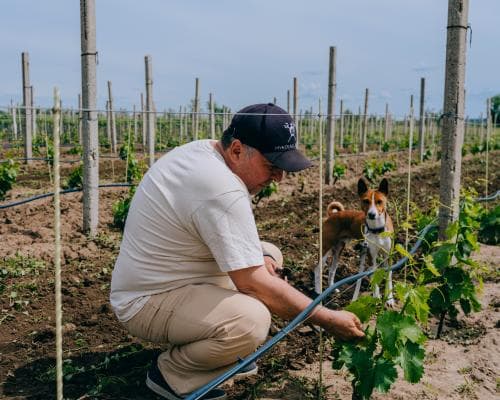
It is a scene of almost absurd tranquility. Mykhailo Molchanov, secateurs in hand, trims foliage from his vines while his dog, Direktor, pads along at his heels. The air hums with bees and the liquid song of golden orioles. The silvery feathergrass ripples like a tide, wild salvia scents the breeze. Then your eye catches it: a Russian rocket, nose-down, half-buried in the soil between the Chardonnay. Unexploded. The Molchanovs have decided to leave it there. Removing it would require machinery that would crush too many precious vines. So they simply work around it. This is winemaking in the shadow of war — a daily negotiation between beauty and catastrophe.
The Molchanovs’ organic vineyard unfurls toward the banks of the Southern Buh river, just outside Mykolaiv. Their label, Steppe Wines, is a love letter to the ancient grassland on which the grapes grow — a richly biodiverse ecosystem rare even by Ukraine’s standards. When the full-scale invasion began on 24 February 2022, Mykhailo and his wife, Svitlana, fled their city home and crossed the river to the winery. They soon found themselves trapped between two armies. “You could see the rockets going directly up towards space — as if they were launching cosmonauts,” recalls their son, Heorhii, who is central to the business. The family’s salvation was their wine cellar, which doubled as a bomb shelter. “We used to have a pretty decent 2017 Cabernet down there,” Mykhailo says dryly. “Not any more.”
For the ultra-wealthy traveller accustomed to the polished tasting rooms of Bordeaux or the private chateaux of Tuscany, the Molchanovs’ operation is something else entirely: raw, intimate, and freighted with stakes that have nothing to do with Parker points. The vines are planted directly into the steppe’s native grasses, a method that eschews irrigation and chemical intervention. The result is a wine that tastes of place — of wild herbs, of the river’s breath, of a land that refuses to be subdued. Tasting here is not a transaction; it is an act of witness. Heorhii pours a glass of their Chardonnay, bright and mineral, while gesturing toward the distant rumble of artillery. “This is what resilience tastes like,” he seems to say.
The rarity of this experience cannot be overstated. There is no hotel, no spa, no concierge. Access is arranged through quiet, bespoke channels — often via philanthropic networks or private art foundations that organise small, curated journeys to Ukraine’s cultural frontiers. The price is not listed in any brochure; it is negotiated in trust and purpose. A visit might include a walk through the vineyard with Mykhailo, a lunch of local cheese and charcuterie on a weathered table, and a long conversation about what it means to believe in the future when the present is so uncertain. The Molchanovs have no intention of leaving. “To make wine is to believe in the future,” Mykhailo says. “We are not going anywhere.”
This signals a subtle but profound shift in the landscape of luxury travel. The old markers — Michelin stars, infinity pools, private butlers — are no longer enough. The new elite seeks meaning, not just comfort. They want to touch something real, to stand in a place where history is being written in real time, to share a glass with people who embody a kind of grace under pressure that no five-star hotel can manufacture. Ukraine’s frontline wineries, of which the Molchanovs are the most compelling example, offer exactly that: a chance to witness the human spirit at its most stubbornly creative.
Where, then, do the wealthy go next? Not to a new island or a newly opened resort, but to the edges — of geopolitics, of endurance, of hope. The Molchanovs’ vineyard is not a destination for everyone. It is for those who understand that the most profound luxury is the ability to be present, fully and vulnerably, in a place that matters. The rocket stays in the ground. The vines keep growing. And the wine, when you taste it, tastes like tomorrow.