South Africa's Xenophobia Crisis: A $400 Billion Wealth Reputation at Risk
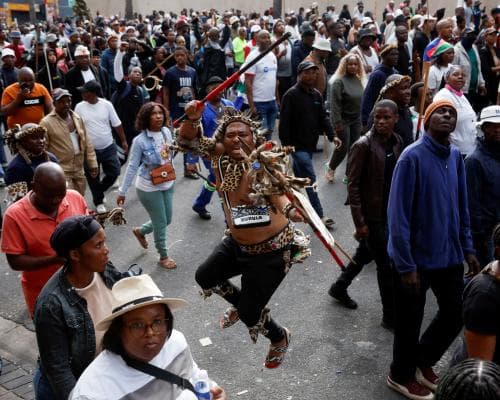
When Nelson Mandela warned against the hatred of foreigners three decades ago, he was defending a fragile economic promise. That promise is now under siege. This week, thousands marched through South African cities, setting an arbitrary deadline for migrants to leave. More than 25,000 people fled in the preceding weeks. Mozambique reports five nationals killed. Ghana says one of its citizens was murdered on Monday. This isn't just a humanitarian tragedy. It's a wealth story.
South Africa's wealthy have long banked on the country's status as Africa's most sophisticated financial hub. The Johannesburg Stock Exchange hosts over $1 trillion in market capitalization. Family offices in Cape Town and Johannesburg manage portfolios built on mining royalties, retail empires, and private equity stakes. But xenophobic violence sends a brutal signal to global capital: governance is fraying, and the social contract is tearing. For the ultra-wealthy, that means one thing: risk repricing.
The mechanics are ugly and familiar. Unemployment sits above 40%. Inequality is among the world's worst. Crime is endemic. Public services are stretched thin. Poorer South Africans, desperate for scapegoats, blame migrants — who make up less than 5% of the population — for stealing jobs and draining resources. The government's response has been tepid. President Cyril Ramaphosa's administration, already battling corruption scandals and energy blackouts, now faces a credibility crisis that reaches directly into the portfolios of the country's richest families.
Here's the capital angle: South Africa's wealthy are not monolithic. Some are deeply tied to the domestic economy — mining magnates, retail barons, property developers. Their net worth is directly correlated with social stability. Others have already diversified globally, parking billions in London real estate, Swiss accounts, and US tech stocks. For the latter, this crisis is a reminder to accelerate that diversification. For the former, it's a nightmare. A sustained wave of violence could trigger capital controls, currency depreciation, and a selloff in South African bonds. The rand has already weakened 8% against the dollar this year. That trend could accelerate.
The rarity here is not the violence itself — it's the timing. South Africa was supposed to be past this. The post-apartheid dream was one of inclusive growth, of a rainbow nation that attracted foreign capital and talent. Instead, the country is reliving its darkest instincts just as global investors are hunting for yield in emerging markets. The MSCI South Africa index has underperformed its emerging market peers by 12% over the past 12 months. A xenophobia-driven risk premium could widen that gap further.
What does this signal for the wealthy? First, that political risk in South Africa is no longer just about Eskom and load-shedding. It's about social cohesion. Second, that the window for exiting or hedging South African exposure may be narrowing. Third, that the country's reputation as a stable gateway to African markets is being actively undermined by its own citizens. For family offices and institutional investors, the calculus is brutal: do you hold, hoping the violence fades, or do you trim positions and wait for a clearer signal?
The forward look is sobering. Xenophobic violence doesn't resolve unemployment or fix broken schools. It destroys the very thing South Africa needs most: trust. Trust from international investors. Trust from skilled migrants who start businesses and pay taxes. Trust from the wealthy that their capital is safe. Without that trust, the country's $400 billion private wealth ecosystem — the largest in Africa — becomes a target for flight. The smartest capital is already moving. The question is how fast the rest will follow.
More in MONEY